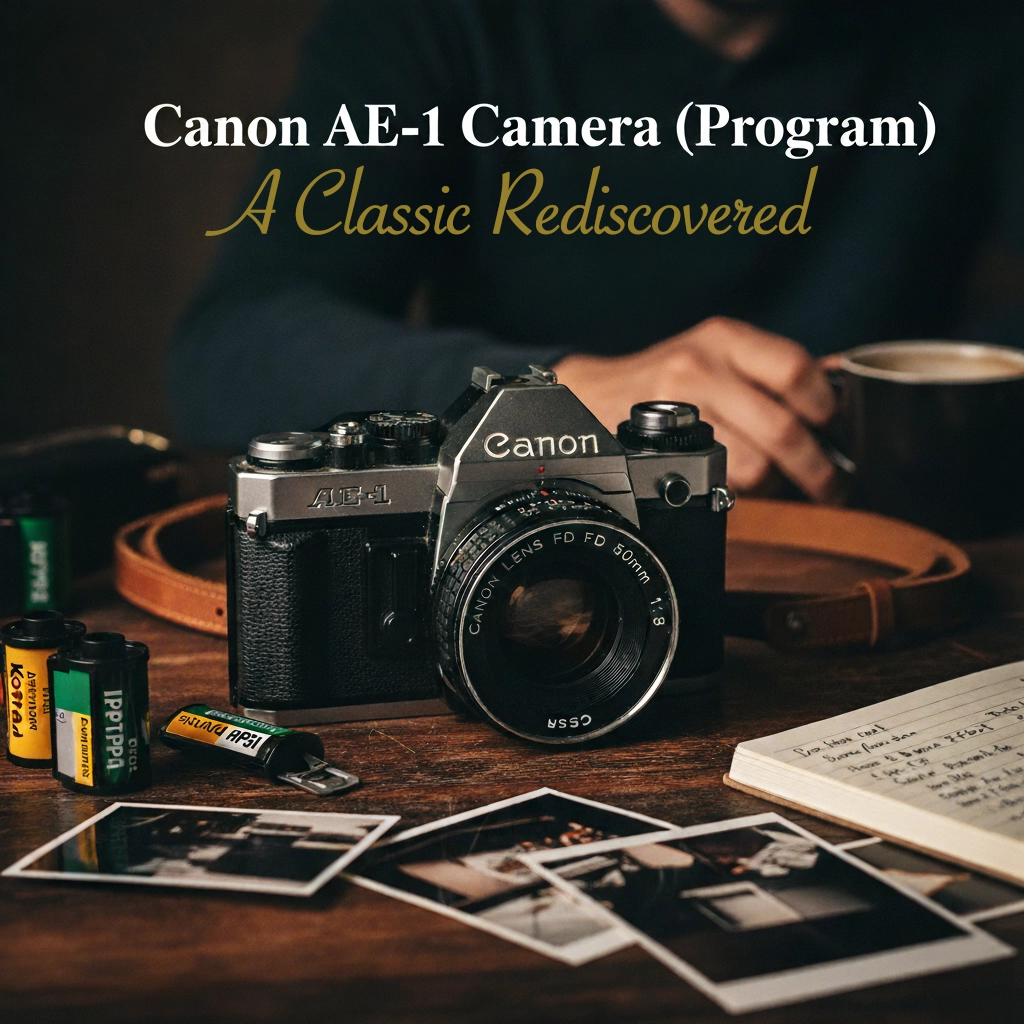
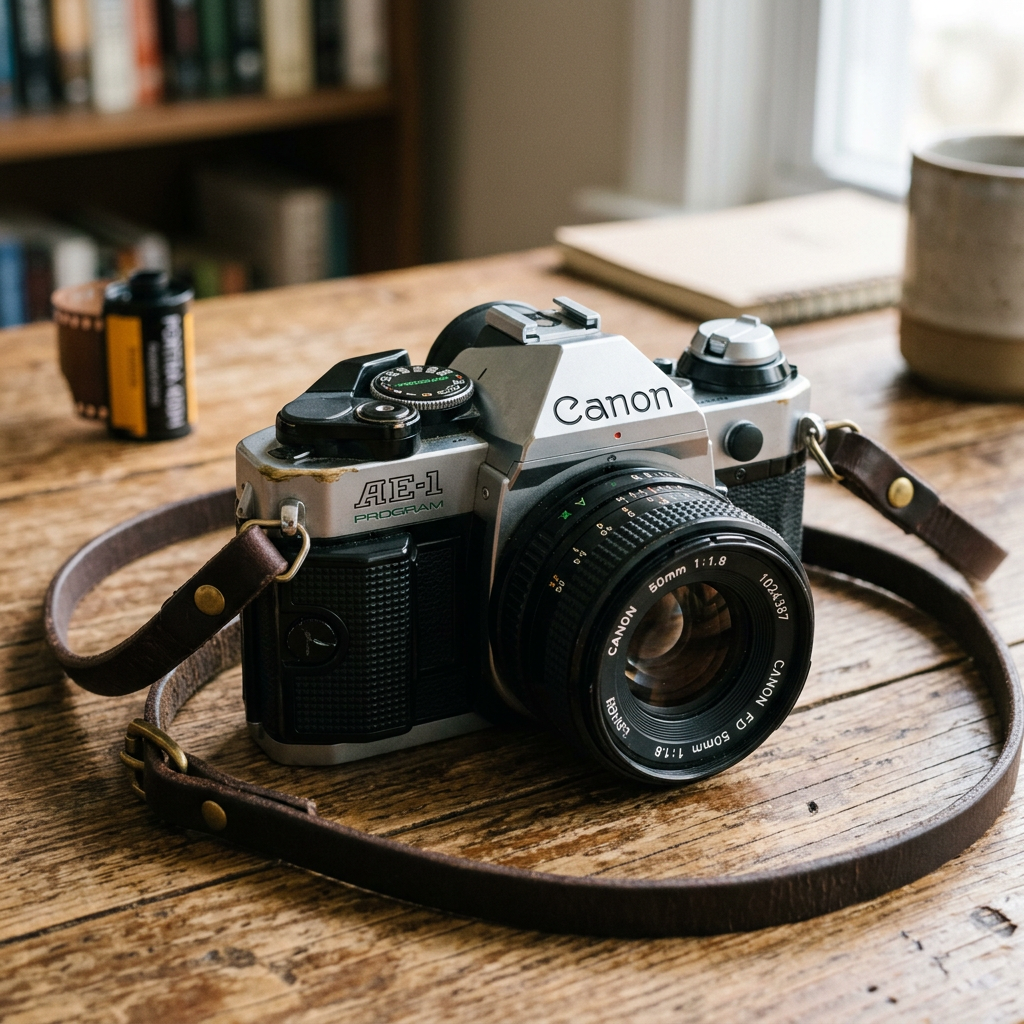
The Canon AE-1 Program is the camera I learned to slow down with. Introduced in 1981 and produced until 1985, it was one of the most popular 35mm SLRs ever made — and for good reason. It is approachable enough for a complete beginner, capable enough for serious work, and possessed of a character that no amount of digital convenience has managed to replicate. I have carried mine on Scottish road trips, through ancient Hampshire landscapes, and into the kind of situations where you need a camera that simply gets on with it. This is an honest personal review built around real use and real results.
| Camera at a Glance — Canon AE-1 Program | |
|---|---|
| Camera | Canon AE-1 Program |
| Produced | 1981–1985 |
| Film Format | 35mm (135 format) |
| Lens Mount | Canon FD |
| Lenses Used | Canon FD 28mm f/2.8, Canon FD 50mm f/1.8 |
| Exposure Modes | Program Auto, Shutter Priority |
| Shutter Speed Range | 2s to 1/1000s + Bulb |
| Metering | Centre-weighted average, TTL |
| Film Speed Range | ISO 25–3200 |
| Flash Sync | 1/60s |
| Battery | 4LR44 / 4SR44 6V |
| Weight | 590g body only |
What Is the Canon AE-1 Program?
The Canon AE-1 Program arrived in 1981 as an upgrade to the original AE-1 — already one of the best-selling cameras of the 1970s. The Program model added a fully automatic program exposure mode, allowing the camera to select both aperture and shutter speed based on available light. For its time this was a significant step forward, and it made the AE-1 Program one of the most accessible serious cameras available. It sold in vast numbers and became the camera that introduced an entire generation to SLR photography.
Four decades later, it remains one of the most sensible entry points into 35mm film photography. The program mode removes the technical barrier for beginners while the shutter priority mode gives experienced photographers genuine creative control. The Canon FD lens mount, though not compatible with modern Canon EF or RF bodies, supports a wide and affordable range of excellent optics — fast primes, wide angles, short telephotos — all available second-hand at a fraction of their original cost. And the camera itself, built from quality materials with a straightforward mechanical layout, remains dependable in daily use when well maintained.
In a world of instant results and infinite review, the AE-1 Program slows everything down. You get thirty-six frames, no preview, and no take-backs. And that, it turns out, is exactly what good photography sometimes needs.
Build Quality and Handling
The AE-1 Program is a compact, well-balanced camera that sits comfortably in the hand. At 590g body only it is noticeably lighter than a medium format camera like the Bronica ETRSi, and it carries that lightness as a genuine advantage — particularly on the kind of all-day road trips where you want a camera in your hand rather than in the bag.
The controls are simple and logically laid out. The shutter speed dial runs across the top plate; the mode selector sits beside it. Film advance is a satisfying single-stroke lever on the right. The viewfinder is bright and clear, with a central focus aid and a needle display showing the selected shutter speed. There is nothing superfluous here — everything serves a purpose, and after a short time the camera becomes genuinely transparent, disappearing between you and the subject.
Program Mode and Shutter Priority
The program mode is the AE-1 Program’s defining feature and its most useful one for photographers coming to film from digital. With the mode dial set to Program, the camera handles both aperture and shutter speed automatically — leaving you to concentrate entirely on composition, focus, and timing. For documentary work, travel, and situations where the light is changing quickly, this is genuinely valuable.
As you become more confident, shutter priority mode opens up creative possibilities that program mode can’t offer. Setting a slow shutter speed — 1/15s or 1/8s — and panning with a moving subject produces motion blur effects that have a character quite different from digitally produced equivalents. Fast shutter speeds freeze movement with the distinctive quality that film renders differently from a digital sensor. For more on exploiting shutter speed creatively, see my posts on motion blur photography and ICM photography.
The FD Lens System — Affordable Excellence
The Canon FD lens mount is one of the great bargains of the second-hand camera market. The lenses produced for it during the 1970s and 1980s are optically excellent — sharp, well-corrected, and capable of a rendering quality that competes with modern glass at a fraction of the price. The 50mm f/1.8 FD is a particularly fine standard lens: light, fast, and genuinely sharp from f/2.8 onwards. The 28mm f/2.8 gives a wider, more environmental perspective well suited to street photography and landscape work where you want to place a subject in its context.
I use both on my AE-1 Program depending on the subject. The 50mm for intimate work — street scenes, details, portraits. The 28mm when I want the landscape in the frame alongside the subject, or when I’m working in tighter spaces where a standard focal length feels too compressed. Neither lens has cost me a significant amount, and both produce results I am entirely happy to print and exhibit.
A Scottish Road Trip — The AE-1 Program in Action
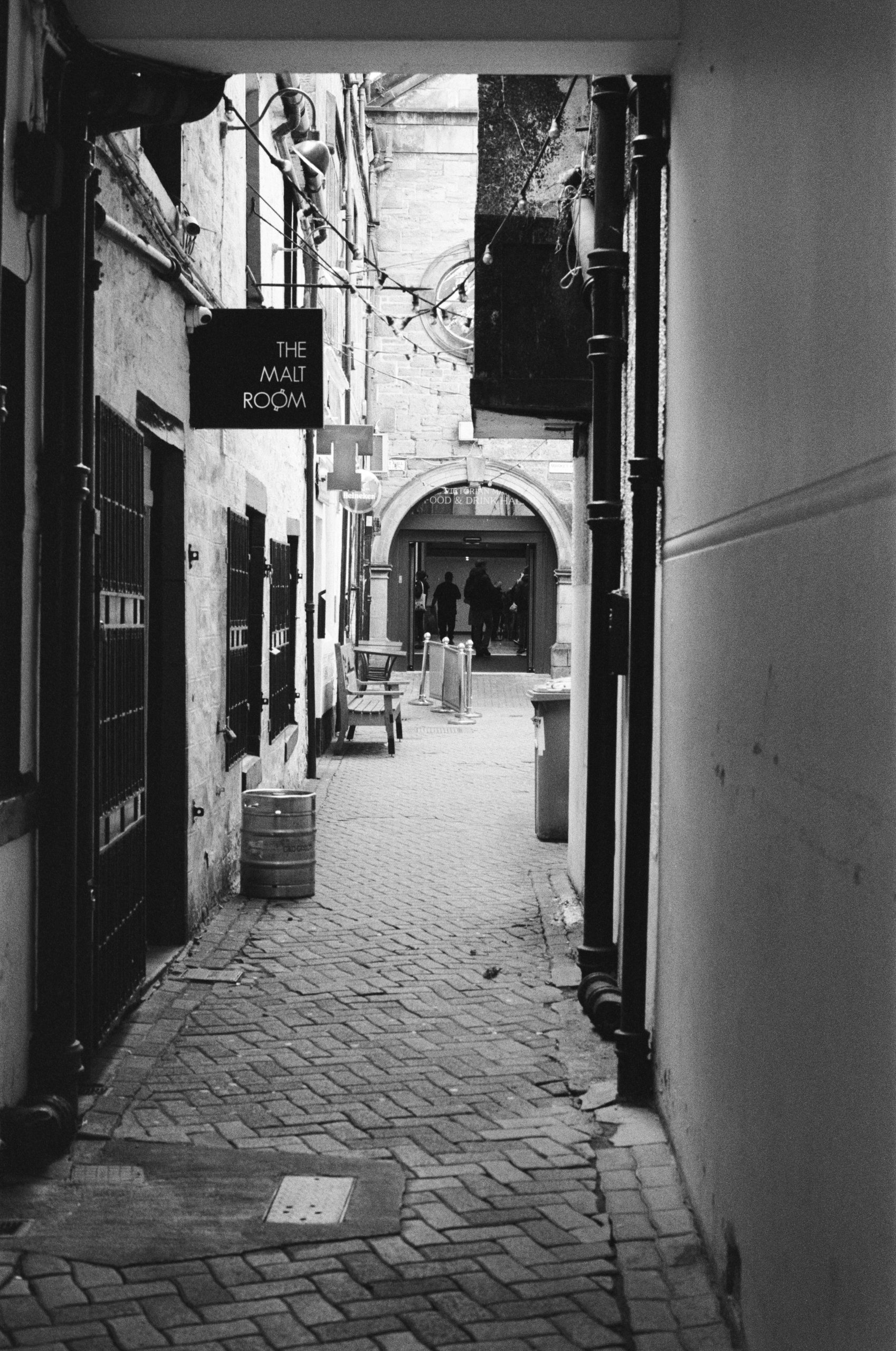
The images in this review come from a road trip through Scotland in 2023 — one of those journeys where the light changes every twenty minutes and the landscape offers something new around every bend. Scotland in this regard is a photographer’s gift and a photographer’s challenge simultaneously: the scale is enormous, the weather is unpredictable, and the temptation to stop every half mile is overwhelming.
The AE-1 Program handled all of it without complaint. In program mode it metered consistently across a wide range of lighting conditions — from the bright overcast of a west coast afternoon to the deeper shadows of a Highland glen. The colour film I had loaded rewarded the Scottish light generously, rendering the greens of the hillsides and the grey-blue of the lochs with the particular warmth and depth that film handles differently from digital.
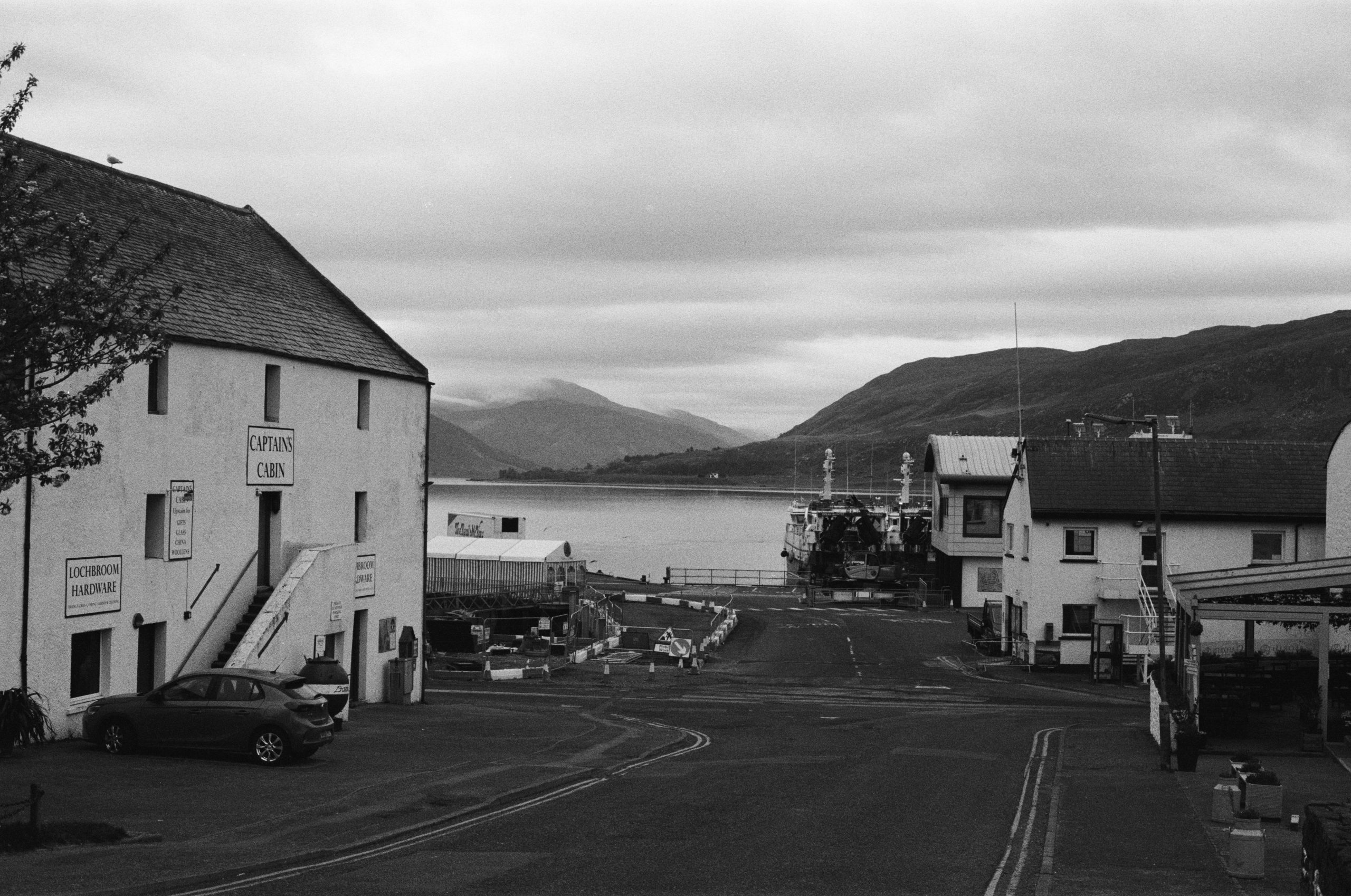
The loch image is characteristic of what the AE-1 Program does best in the field — a quickly seized moment, handheld, in changing light, where the program mode made the exposure decision instantly and correctly. There was no time to think about aperture or shutter speed. The camera thought for me, and the result is exactly what I saw. That is what a good program mode should do.
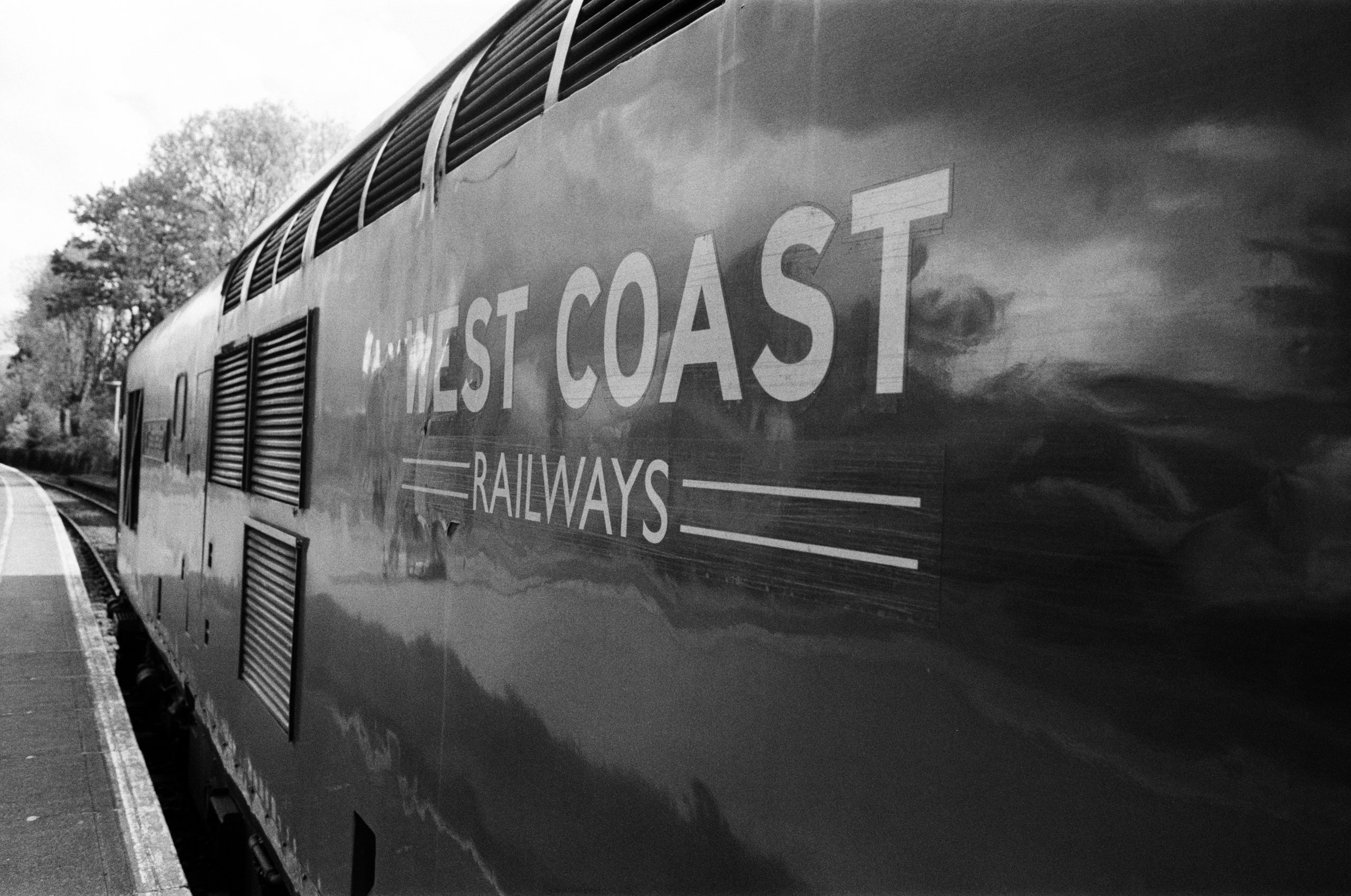
The locomotive image illustrates something else the AE-1 Program handles well — close detail work where the 50mm lens at a moderate aperture produces a shallow depth of field that separates the subject cleanly from the background. The paintwork detail and the colour rendering here are exactly why I continue to carry this camera alongside more technically capable modern equipment. Film does something to colour that remains genuinely difficult to replicate in post-processing.
Which Films Work Best in the Canon AE-1 Program?

| Film | Why It Works Well in the AE-1 Program |
|---|---|
| Ilford HP5 Plus 400 | The most versatile black and white starting point — handles variable light, pushes well to ISO 800 or 1600, and suits the AE-1’s program metering beautifully. See my HP5 Plus review. |
| Kodak Tri-X 400 | A classic pairing — Tri-X’s assertive grain and high contrast suit street and documentary work perfectly. See my Tri-X review. |
| Kodak UltraMax 400 | A reliable, forgiving colour film with a warm tonality that suits travel and landscape work. Wide latitude makes it an excellent choice for program mode shooting. See my Kodak UltraMax review. |
| Kodak Gold 200 | A slower colour film with a classic, slightly warm rendering — ideal for bright daylight conditions. See my Kodak Gold review. |
| Kentmere Pan 400 | An affordable black and white option well suited to learning — forgiving latitude and consistent results at a lower cost than HP5. See my Kentmere Pan 400 review. |
| Lomography Lady Grey 400 | A distinctive ISO 400 black and white film with a cool tonality that suits street and urban work. See my Lady Grey review. |
For help choosing between these — and understanding which film suits which conditions — see my guide to choosing the right film and my overview of types of 35mm black and white films. For pushing film beyond box speed — something the AE-1 Program handles well in shutter priority — see my guide to pushing film explained.
Canon AE-1 vs AE-1 Program — What’s the Difference?
| Feature | Canon AE-1 | Canon AE-1 Program |
|---|---|---|
| Introduced | 1976 | 1981 |
| Program Auto Mode | No | Yes |
| Shutter Priority | Yes | Yes |
| Metering | TTL centre-weighted | Improved TTL centre-weighted |
| Max Shutter Speed | 1/1000s | 1/1000s |
| Best For | Experienced shooters who know exposure | Beginners and versatile everyday use |
The practical difference is the program mode. If you already understand exposure and are happy to shoot in shutter priority or manual, the original AE-1 is a perfectly capable camera at a slightly lower second-hand price. If you are newer to film photography and want the option of full automation while you find your feet, the Program model is the better investment. For a broader look at classic 35mm cameras and how they compare, see my guide to 10 vintage 35mm film cameras.
What Works Well
- Program mode — genuinely excellent for beginners and fast situations
- Shutter priority gives real creative control as you progress
- Lightweight and well-balanced — comfortable for all-day use
- Access to the full Canon FD lens range — affordable and excellent
- Bright, clear viewfinder with useful exposure display
- Reliable metering across a wide range of conditions
- Widely available second-hand at very reasonable prices
- Excellent choice for pushing and pulling film
Worth Knowing
- FD lenses not compatible with modern Canon EF or RF bodies
- No aperture priority mode — a limitation for some workflows
- Electronic shutter means battery dependency — always carry a spare
- Flash sync at 1/60s only — limiting in bright conditions with flash
- Second-hand condition varies — buy from reputable sources
Is the Canon AE-1 Program good for beginners?
It is one of the best beginner film cameras available. The program auto mode removes the technical barrier of exposure while still using a proper SLR system with interchangeable lenses. As your confidence grows, shutter priority mode gives you increasing creative control. The wide availability of affordable FD lenses means you can expand your kit without significant outlay. For a broader introduction to film photography, see my film photography guide.
What lenses fit the Canon AE-1 Program?
The AE-1 Program uses the Canon FD lens mount, which supports the full range of Canon FD and Canon FL lenses produced between the late 1960s and the early 1990s. These include an excellent range of fast primes — the 50mm f/1.4 and f/1.8, the 28mm f/2.8, the 35mm f/2 — as well as zooms and longer telephotos. FD lenses are not compatible with modern Canon EF or RF mount cameras. For a broader look at vintage camera and lens combinations, see my guide to 10 vintage 35mm film cameras.
What film should I use in the Canon AE-1 Program?
For black and white, Ilford HP5 Plus 400 is the most forgiving and versatile starting point — it handles the program mode’s metering well and pushes cleanly if you need more speed. For colour, Kodak UltraMax 400 is an excellent all-rounder. For a broader guide to film selection, see my post on choosing the right film.
Can you push film in the Canon AE-1 Program?
Yes — the AE-1 Program is well suited to pushing film. Set the film speed dial to your intended push speed (ISO 800 or 1600 for HP5, for example), shoot normally, and inform your lab or adjust your development accordingly. The shutter priority mode gives you additional control over the exposure when pushing. For a full guide to the technique and real-world results, see my post on pushing film explained.
How does the Canon AE-1 Program compare to the Canon EOS 300V?
The AE-1 Program is an older, FD-mount camera with a more limited feature set but a distinctive mechanical character and a warmer, more tactile shooting experience. The Canon EOS 300V is a more modern EF-mount body with autofocus, a wider range of exposure modes, and compatibility with the full Canon EF lens range. Both are excellent 35mm cameras for different reasons — the AE-1 Program for its character and simplicity, the 300V for its versatility and modern lens compatibility.
Where can I buy a Canon AE-1 Program?
The AE-1 Program is widely available second-hand through eBay, MPB, and specialist camera dealers. Prices have risen in recent years due to renewed interest in film photography, so condition and completeness vary. Always check that the shutter fires at all speeds, the light seals are intact, and the viewfinder is clear before purchasing. A working example with a 50mm lens represents excellent value and a genuinely capable shooting system.
Does the Canon AE-1 Program need batteries?
Yes — the AE-1 Program uses a 6V silver oxide battery (4LR44 or 4SR44) to power the electronic shutter and metering system. Without a working battery the camera will not fire. Always carry a spare, particularly on longer trips. The battery is widely available and inexpensive, and a fresh one typically lasts through many rolls of film in normal use.
This article is part of my Photography Kit Reviews hub. For more camera reviews, see my guides to the Zenza Bronica ETRSi, Canon EOS 300V, and Canon EOS 5DS R. For film reviews to pair with this camera, visit my Film Photography hub.