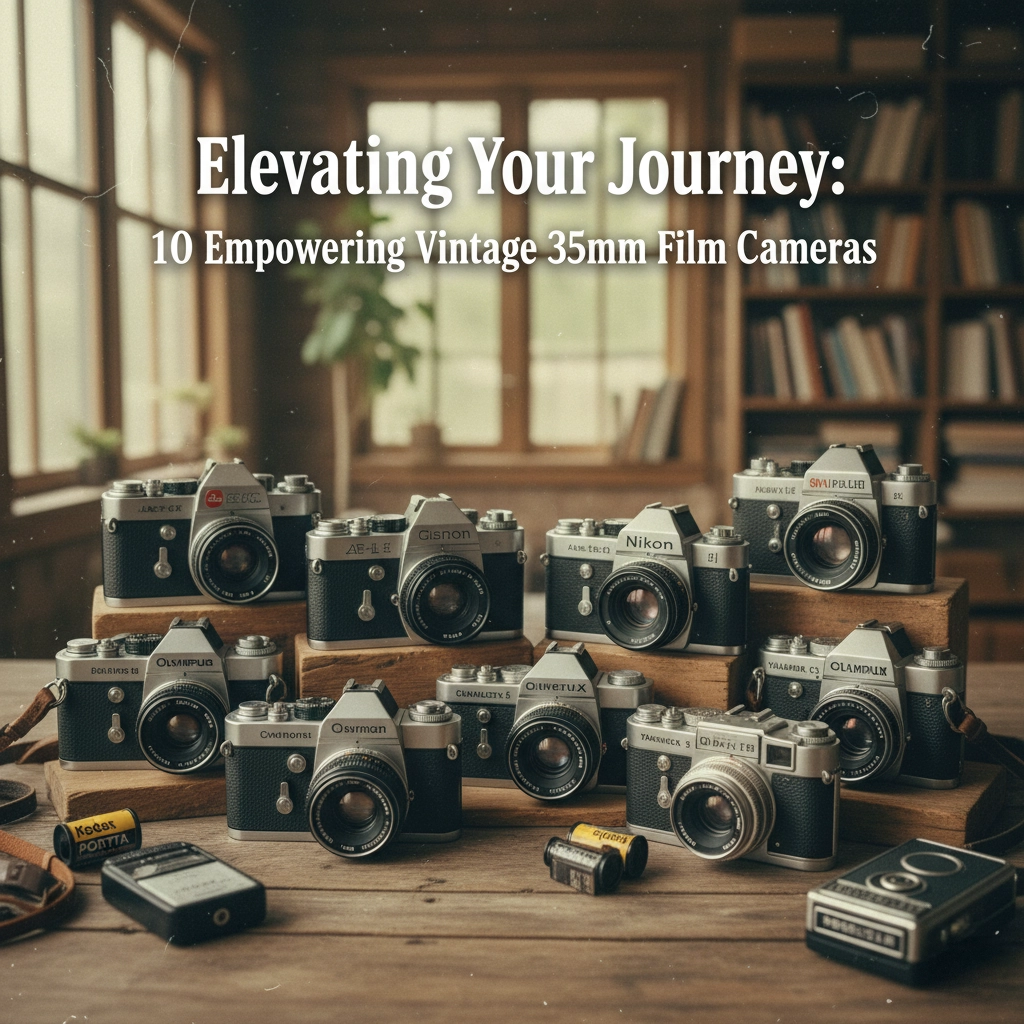
Film photography asks something different of you than digital. It asks for patience, deliberation, and a willingness to work within limits — limits that turn out, in practice, to be creative freedoms. The cameras that impose those limits most productively are often the ones built decades ago, when mechanical reliability and optical quality were the only criteria that mattered. This is a personal guide to ten of the finest vintage 35mm film cameras available on the second-hand market today — what each does well, who it suits, and what you should expect to pay.
A vintage 35mm camera does not give you instant feedback, does not bracket automatically, and does not let you take fifty frames and choose the best one. It gives you thirty-six chances to get it right. That constraint, once accepted, becomes the point.
What Vintage 35mm Film Cameras Give You That Digital Cannot
The revival of interest in film photography over the past decade is sometimes explained as nostalgia, but that explanation misses something important. Film does things that digital does not — and not just aesthetically. The grain structure of a well-exposed negative has a different quality to digital noise. The tonal gradation of a film image handles highlights and shadows with a curve that digital sensors render differently. And the process of working with a finite number of frames — knowing that each one costs something in film and development — produces a different quality of attention that most photographers find improves their work.
The vintage cameras that shoot 35mm film are also, in many cases, simply very good cameras. The optics produced by Canon, Nikon, Olympus, Leica, and Pentax during the 1960s, 1970s, and 1980s remain outstanding by any current standard. A Canon FD 50mm f/1.4 or a Nikkor-S 50mm f/1.4 from forty years ago will produce images that compare favourably with modern equivalents at a fraction of the price. For a broader introduction to the pleasures and practicalities of film photography, see my film photography guide and my comparison of film vs digital photography.
The Canon AE-1 Program is the camera that introduced more people to 35mm film photography than any other — and it remains one of the most sensible starting points today. Introduced in 1981, it offers program auto exposure for beginners, shutter priority for more experienced photographers, and access to Canon’s excellent FD lens range. It is light, well balanced, and entirely practical for all-day shooting.
Prices have risen as film photography has revived, but it remains good value for what it offers. The FD lens system — particularly the 50mm f/1.8 and 28mm f/2.8 — delivers outstanding results at modest second-hand prices. For my full personal review of this camera, see my Canon AE-1 Program review.
Best for: Anyone starting out in film photography, travel and street work, photographers who want simplicity without sacrificing capability. Not ideal for: Those who need aperture priority mode — the AE-1 Program offers program and shutter priority only.
The Nikon FM2 is a fully mechanical 35mm SLR that requires no battery to fire the shutter — a characteristic that gives it a reliability in extreme conditions that electronic cameras cannot match. Its titanium honeycomb shutter reaches 1/4000s and synchronises with flash at 1/250s — specifications that were remarkable at its 1982 introduction and remain genuinely useful today. The FM2 uses the Nikon F mount, giving access to arguably the finest and most extensive vintage lens ecosystem available.
It is a camera for photographers who want to understand and control every aspect of exposure. There are no automatic modes — you meter, set aperture and shutter speed, and fire. The discipline this imposes is one of the most effective ways to genuinely learn photography. Built to withstand serious field use, it remains one of the most reliable manual SLRs ever produced.
Best for: Experienced photographers who want full manual control, harsh environment shooting, and access to the Nikon F lens system. Not ideal for: Beginners or those who want any degree of automatic exposure assistance.
The Pentax K1000 is the camera that photography schools around the world used for decades to teach students the fundamentals of exposure, and for good reason. It is purely mechanical, almost indestructible, and entirely without automation — there is no program mode, no aperture priority, no shutter priority. Just aperture, shutter speed, and a match-needle meter. Learning on a K1000 means learning photography properly, and many photographers regard that as its greatest strength.
The Pentax K mount gives access to a wide range of M42-adapter-compatible lenses as well as the full range of Pentax K-series glass. Build quality is outstanding for a camera at this price point — K1000s from the late 1970s are regularly found in full working order today.
Best for: Learning exposure fundamentals, photography students, anyone who wants to develop proper manual technique. Not ideal for: Photographers who need any form of automatic assistance or fast shooting capability.
The Leica M3, produced from 1954 to 1966, is the camera against which all other 35mm cameras are ultimately measured. Its rangefinder viewfinder — bright, clear, with 0.91x magnification — remains the finest ever fitted to a 35mm camera. The cloth shutter is whisper-quiet. The build quality is extraordinary. The Leica M lens system, with its Summicron and Summilux optics, produces results that no other lens system at any price reliably surpasses.
It is expensive, even second hand, and the prices of genuinely good examples have risen considerably as demand has outstripped supply. But for photographers who can afford it and who are drawn to the particular discipline of rangefinder photography — the pre-visualisation required, the slower and more deliberate approach — there is nothing in 35mm that equals the experience of shooting a Leica M3 with a Summicron lens.
Best for: Street photography, documentary, reportage, and any work where discretion and a direct optical connection to the subject matter most. Not ideal for: Close-up work, sports and action, or photographers on any kind of budget.
The Minolta X-700 is one of the most underrated cameras on this list — a fully featured 35mm SLR offering program, aperture priority, and manual exposure modes at a second-hand price that consistently undervalues what it delivers. Introduced in 1981, it is the flagship of Minolta’s X-series and benefits from the excellent Rokkor and MD lens range — glass that is frequently cited as among the sharpest and most characterful 35mm optics ever produced by a Japanese manufacturer.
For photographers who want a capable manual SLR with aperture priority and excellent lens options at a fraction of the Canon or Nikon price, the X-700 consistently surprises. It is comfortable to use, well metered, and produces results that reflect the quality of the lenses rather than any limitation of the body.
Best for: Landscape, street, and general photography on a budget. An excellent choice for photographers who want aperture priority without paying Canon or Nikon prices. Not ideal for: Those who need access to a wider lens ecosystem or who specifically require a Canon or Nikon mount.
The Olympus OM-1 redefined what a professional 35mm SLR could weigh when it was introduced in 1972. Dramatically smaller and lighter than the Nikon F or Canon F-1 of the same era, it offered fully mechanical operation, a large and clear viewfinder, and access to the Olympus Zuiko lens range — one of the finest optical systems ever produced for 35mm photography. The OM-1 requires no battery to fire the shutter, only for the meter.
Its compact dimensions make it one of the most comfortable manual SLRs to carry over a long day, and the Zuiko lenses — the 50mm f/1.4, the 28mm f/2, the 21mm f/3.5 — are highly regarded for their rendering quality and character. It remains one of the best manual SLR options available at its price point.
Best for: Travel, landscape, and any work where a smaller, lighter manual SLR is an advantage. Not ideal for: Photographers who need any form of automatic exposure — the OM-1 is manual only.
The Yashica Electro 35 is the most accessible route into rangefinder photography for most photographers. Its automatic aperture-priority exposure system removes the exposure calculation that can intimidate newcomers to rangefinder shooting, while the 45mm f/1.7 Yashinon lens is surprisingly capable — sharp, with a rendering quality that punches well above the camera’s price. The rangefinder viewfinder, while not in the Leica class, is clear and functional.
It is not a camera for serious professional work, and the electronic shutter requires a working battery to fire. But as an introduction to rangefinder composition and the particular pleasures of a fixed-lens shooting discipline, it offers exceptional value at its second-hand price. For many photographers it is the camera that reveals whether rangefinder photography suits their way of working — before committing to a Leica.
Best for: Introduction to rangefinder photography, street work on a budget, photographers curious about fixed-lens shooting. Not ideal for: Close-up work, photographers who need interchangeable lenses, or serious professional use.
The Contax T2 is a titanium-bodied compact camera fitted with a Carl Zeiss 38mm f/2.8 Sonnar lens — a combination that produces results significantly better than the camera’s compact form factor might suggest. The Zeiss Sonnar has a rendering quality that is immediately recognisable: sharp, contrasty, with a particular three-dimensionality in the way it draws subjects against backgrounds that cheaper lenses cannot approach.
Prices have risen dramatically as its reputation among street and travel photographers has spread — it has become something of a celebrity camera, which has not helped its second-hand value for buyers. If you can find a good example at a reasonable price, it rewards the investment. For everyday carry photography where image quality rather than versatility is the priority, it is difficult to better.
Best for: Travel and street photography where a pocketable camera with genuine optical quality is the priority. Not ideal for: Photographers who need interchangeable lenses or who baulk at the current second-hand prices.
The Rollei 35, introduced in 1966, was the smallest 35mm camera in the world at its launch — and it remains remarkably compact by any standard. Fitted with either a Carl Zeiss Tessar or Schneider Kreuznach Xenar 40mm f/3.5 lens depending on the variant, it produces genuinely excellent results from a package that fits in a shirt pocket. The fully mechanical operation and the quality of the optics make it a camera that rewards the effort of learning its slightly unconventional controls.
The viewfinder is frameline only — no rangefinder coupling — so focus is estimated by scale, which requires some practice. But for landscapes and travel subjects where depth of field at moderate apertures makes precise focus less critical, it is one of the most practical and capable compact film cameras available at any price.
Best for: Travel photography where minimum size is the priority, landscape and street work at moderate apertures. Not ideal for: Low-light work where precise focus at wide apertures is essential, or photographers unfamiliar with scale focusing.
The Fujifilm Quicksnap earns its place on this list not for optical quality but for what it represents: the lowest possible barrier to entry for film photography. Loaded with ISO 400 colour negative film and fitted with a fixed 32mm f/10 lens optimised for sunny daylight shooting, it produces results that are characterful, sometimes beautiful, and entirely unpredictable. The lack of control is, for many photographers, the point.
The Quicksnap is also the camera that many people use to discover whether they enjoy the film photography process before investing in something more serious. If you finish a roll and find yourself wanting more control, more quality, and more deliberateness, the cameras higher up this list are waiting. If you find the randomness and simplicity entirely satisfying, you have found your camera. For guidance on next steps, see my film photography guide and my guide to choosing the right film.
Best for: Absolute beginners, events and parties, travel photography with no investment risk. Not ideal for: Anyone who wants control, quality, or a camera that can be developed beyond its factory settings.
Which Camera Is Right for You?
| If You Want | Best Choice | Why |
|---|---|---|
| Best beginner SLR | Canon AE-1 Program | Program mode, wide lens availability, most forgiving of the manual SLRs. See my full AE-1 Program review. |
| Learn exposure properly | Pentax K1000 | No automation whatsoever — forces you to understand metering, aperture, and shutter speed. |
| Best mechanical reliability | Nikon FM2 | Fully mechanical — fires without a battery. Titanium shutter rated to 150,000 cycles. |
| Best value overall | Minolta X-700 | Full exposure modes, excellent Rokkor lenses, consistently underpriced on the second-hand market. |
| Compact manual SLR | Olympus OM-1 | Smallest and lightest fully mechanical professional SLR — Zuiko lenses are outstanding. |
| Rangefinder experience | Yashica Electro 35 | The most affordable introduction to rangefinder photography before committing to Leica. |
| The very best | Leica M3 | The finest 35mm camera ever made for the work it was designed for. If budget allows. |
| Premium compact | Contax T2 | Zeiss optics in a pocketable body. Expensive but optically exceptional. |
| Smallest possible | Rollei 35 | Genuinely shirt-pocket sized with real optical quality — Zeiss or Schneider glass. |
| No commitment | Fujifilm Quicksnap | The simplest possible introduction to film photography with nothing to lose. |
Which Films Work Best in Vintage 35mm Cameras?
The film you choose matters as much as the camera. Each of the cameras on this list will respond differently to different emulsions, and finding the combination that suits your subject and your way of working is part of the pleasure of film photography. For detailed reviews of the films I use most, visit my Film Photography hub.
| Film | Why It Works in Vintage 35mm Cameras |
|---|---|
| Ilford HP5 Plus 400 | The most versatile black and white starting point — handles variable light, pushes well to ISO 1600, and suits almost any vintage camera. See my HP5 Plus review. |
| Kodak Tri-X 400 | The classic black and white film for street and documentary work — assertive grain and high contrast that suits the character of vintage cameras. See my Tri-X review. |
| Kodak UltraMax 400 | A reliable, forgiving colour film with a warm Kodak tonality — ideal for travel and general shooting in variable light. See my UltraMax review. |
| Kodak Gold 200 | A classic colour film with warm, slightly saturated rendering — suits bright daylight conditions and the golden hour particularly well. See my Kodak Gold review. |
| Ilford FP4 Plus 125 | Fine grain and outstanding tonal range for landscape work in good light. Rewards the deliberate, slower approach that vintage cameras encourage. See my FP4 Plus review. |
| Kentmere Pan 400 | An affordable black and white option — consistent results at lower cost than HP5. See my Kentmere Pan 400 review. |
Can I still buy film for vintage 35mm cameras?
Yes — 35mm film is in active production from Ilford, Kodak, Fujifilm, Lomography, Rollei, and several specialist manufacturers. The range available today is arguably wider than it has been for some years, with both mainstream stocks and niche specialist emulsions available in 35mm. For a guide to sourcing film in the UK, see my posts on where to buy film in the UK and affordable black and white film in the UK.
Are vintage 35mm cameras good for beginners?
Several on this list are excellent for beginners — the Canon AE-1 Program and the Pentax 645 in particular offer enough automation to remove the exposure barrier while still requiring meaningful engagement with the photographic process. The Pentax K1000 and Nikon FM2 are better suited to those who already understand exposure or who specifically want to learn it through practice. For a broader introduction to starting out with film, see my film photography guide.
Can I use vintage lenses on modern digital cameras?
Many vintage lenses can be adapted to modern mirrorless cameras via mount adapters — Nikon F, Pentax K, Olympus OM, Minolta MD, and M42 lenses all have widely available adapters for Sony E, Canon RF, and other modern mounts. Autofocus will not function in most cases, but image quality is often outstanding. Canon FD lenses are an exception — the short flange distance of the FD mount makes adaptation to digital bodies more complicated and often requires optical elements that affect image quality.
What is the best vintage 35mm camera to buy second hand?
The answer depends on your budget and priorities. For the best combination of capability, lens availability, and value, the Minolta X-700 is consistently underpriced and underrated. For the best beginner experience, the Canon AE-1 Program remains the most sensible starting point. For the finest mechanical reliability and lens system, the Nikon FM2 is hard to argue against at its price. And for those whose budget is flexible, the Leica M3 with a Summicron lens is simply in a different category from everything else on this list.
How do I push film in a vintage camera?
Pushing film means setting the camera’s film speed dial higher than the film’s rated ISO — effectively underexposing the film — and then extending development time to compensate. The result is increased grain, higher contrast, and effective use of film in lower-light conditions than its box speed would normally allow. For a full guide to the technique and real-world results, see my post on pushing film explained.
This article is part of my Film Photography hub. For more on shooting film with vintage cameras, see my personal reviews of the Canon AE-1 Program, Canon EOS 300V, and Zenza Bronica ETRSi. For film reviews to pair with any of these cameras, visit my Film Photography hub. For camera kit reviews, visit my Photography Kit Reviews hub.