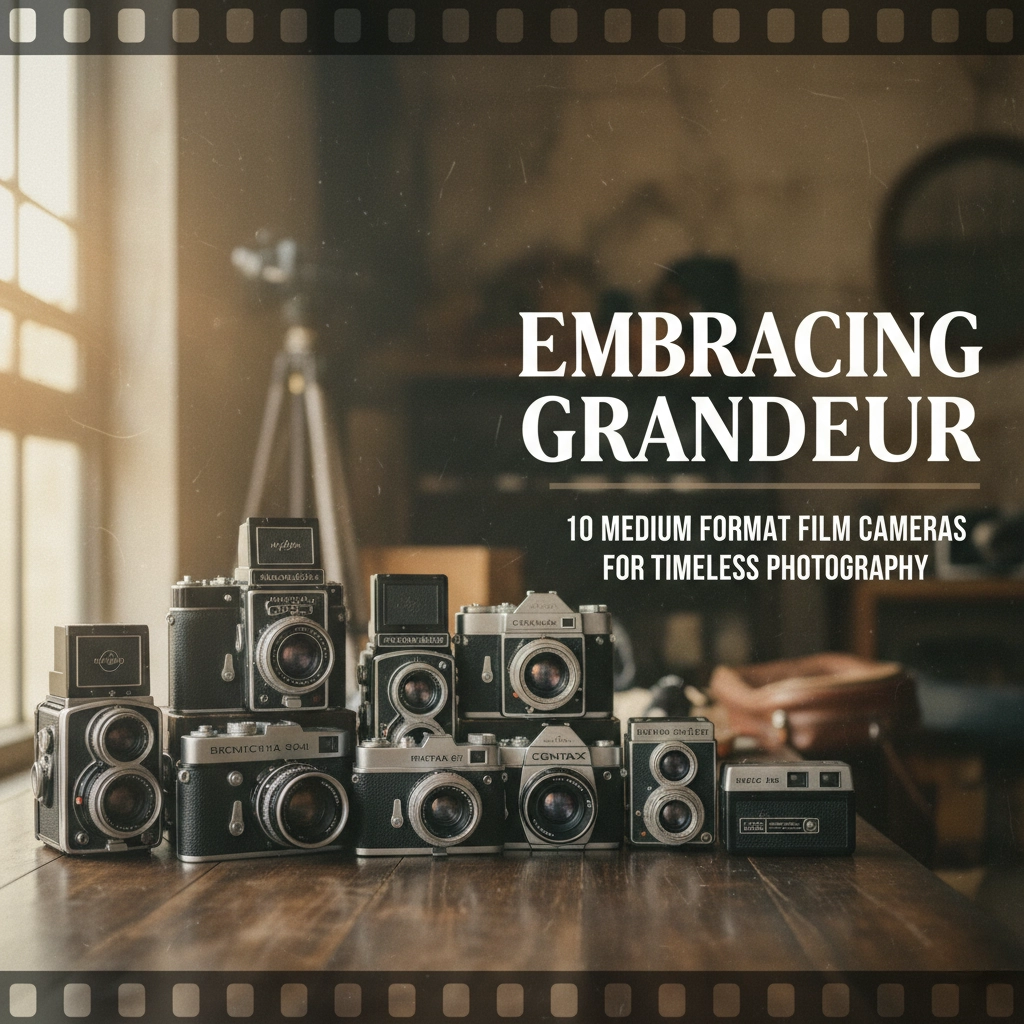
Medium format film photography is one of those commitments that changes the way you see. The larger negative — whether 6×4.5, 6×6, or 6×7 — holds more information, more tonal depth, and more of the quality of light than 35mm can manage. The cameras that produce these negatives range from the extraordinary to the merely very good, and the second-hand market has never offered better access to them than it does now. This is a personal guide to ten of the finest medium format film cameras available — what each does well, who it suits, and what to expect if you’re buying second hand.
The larger negative does not just hold more pixels. It holds more of the quality of light — the subtlety of a tonal transition, the texture of a shadow, the depth behind a highlight. That is what medium format is for.
What Makes Medium Format Film Different?
The defining characteristic of medium format photography is the negative size. Where 35mm film produces a frame of 24×36mm, medium format film produces frames ranging from 6×4.5cm to 6×9cm depending on the camera — between two and five times the negative area. That additional surface area translates directly into finer grain, greater tonal depth, and a quality of image that becomes immediately apparent when you hold a medium format negative to the light for the first time.
The cameras that shoot this film are necessarily larger, heavier, and more deliberate than their 35mm counterparts. Most use 120 roll film, which gives between eight and fifteen frames per roll depending on the negative format. That limitation — so few frames compared to a 36-exposure 35mm roll — is one of medium format’s most valuable characteristics. It slows you down. It makes each frame a considered decision rather than an instinctive reaction. And the discipline it imposes tends to improve the quality of the images that result.
For more on what medium format photography involves in practice, see my guide to medium format photography. For my own experience with the system, see my Zenza Bronica ETRSi review.
| Format | Negative Size | Frames per 120 Roll | Best For |
|---|---|---|---|
| 6×4.5cm | 56×42mm | 15–16 | Versatility, portability, landscape |
| 6×6cm | 56×56mm | 12 | Square composition, studio, portrait |
| 6×7cm | 56×70mm | 10 | Maximum landscape resolution |
| 6×9cm | 56×84mm | 8 | Panoramic landscape and architecture |
The Hasselblad 500C/M is the camera against which all other medium format systems are measured. Produced in Sweden from 1970 to 1994, it is a modular 6×6 SLR built around interchangeable film backs, viewfinders, and Zeiss C-series lenses of exceptional optical quality. The square negative format demands a different compositional approach — one that rewards those who embrace it with images that feel genuinely different from rectangular formats.
The Zeiss lenses — Planar, Distagon, Sonnar — are among the finest ever made for any camera system. The shutter is in the lens rather than the body, giving flash synchronisation at all shutter speeds. The system is expensive, even second hand, but it has never lost its reputation as the finest modular medium format camera ever produced. If your budget stretches to it, there is nothing quite like it.
Best for: Portrait, studio, and considered landscape work where square composition suits the subject. Not ideal for: Handheld documentary or wildlife work — it is a camera that demands a tripod and deliberate approach.
The Mamiya RZ67 is a 6×7 modular SLR of formidable size and capability. The 6×7 negative is the largest practical roll film format — almost five times the area of 35mm — and the RZ67 extracts every bit of that potential through an excellent range of lenses and a rotating film back that allows portrait and landscape orientation without moving the camera. The bellows focusing system gives close focus capability across the full lens range without additional accessories.
It is not a field camera in any conventional sense — the weight and bulk make handheld shooting impractical for most subjects. But on a tripod in a studio or at a carefully chosen landscape location, it produces negatives of extraordinary quality. Second-hand prices are very reasonable given the camera’s capability, making it one of the best value propositions in medium format.
Best for: Studio portraiture, tripod landscape work, close detail photography. Not ideal for: Any situation requiring mobility or rapid response.
The Pentax 645 is one of the most practical medium format cameras ever made. Its 6×4.5cm format gives fifteen frames per 120 roll — more than any other medium format configuration — and the camera handles more like a large 35mm SLR than a traditional medium format body. It has autofocus, motorised film advance, and a comfortable grip that makes handheld shooting genuinely viable. The Pentax 645 lens range is excellent and affordable.
For photographers stepping up from 35mm who want the benefits of medium format without the steep learning curve of a fully manual system, the Pentax 645 is one of the most welcoming entry points available. Second-hand prices are very reasonable and good examples are widely available.
Best for: Landscape, travel, and documentary work. An excellent first medium format camera. Not ideal for: Square composition enthusiasts or those wanting the classic manual medium format experience.
The Mamiya 7 is a rangefinder camera producing 6×7cm negatives — a combination that should be contradictory but is in practice one of the most elegant photographic instruments ever made. Where most 6×7 cameras are enormous and tripod-bound, the Mamiya 7 is genuinely portable, light by medium format standards, and capable of being used handheld in good light. The leaf-shutter lenses are extremely sharp and give flash synchronisation at all shutter speeds.
The rangefinder viewing system suits landscape and travel work perfectly — you see beyond the frame and can anticipate composition in a way that SLR viewfinders don’t allow. It is an expensive camera even second hand and prices have risen considerably as its reputation has spread, but nothing else delivers a 6×7 negative in a package this practical.
Best for: Landscape, travel, and environmental portraiture where portability matters. Not ideal for: Close-up work, studio photography, or photographers accustomed to SLR shooting.
The Rolleiflex 2.8F is a twin-lens reflex camera — one lens for viewing, one for exposing — producing 6×6cm squares on 120 film. The waist-level viewing screen gives a discreet, downward-facing shooting position that changes the relationship between photographer and subject in ways that SLR shooting cannot replicate. The Zeiss Planar 80mm f/2.8 taking lens fitted to the 2.8F is exceptional — sharp, contrasty, and capable of a rendering quality that its age does nothing to diminish.
The Rolleiflex has been the camera of choice for some of the twentieth century’s most significant photographers, and its images are immediately recognisable — the square format, the particular depth of field, the quality of the light. It is a camera that invites a different way of seeing, and for street, documentary, and portrait work it remains one of the finest tools available in any format at any price.
Best for: Street photography, documentary, environmental portrait, and any work where the square format suits the subject. Not ideal for: Close-up work or situations requiring rapid focal length changes.
The Yashica Mat-124G is the most accessible route into twin-lens reflex medium format photography. It produces 6×6 squares on 120 film through a Yashinon 80mm f/3.5 lens that, while not in the Zeiss class of the Rolleiflex, delivers very good results for its price point. Built-in metering simplifies exposure for those new to medium format, and the camera is compact and relatively light by the standards of the format.
It is not a professional tool in the way that the Rolleiflex is, and the quality difference is apparent when you compare the two. But as an introduction to waist-level viewing, square format composition, and the particular pleasure of twin-lens photography, it is genuinely hard to fault at its second-hand price. For many photographers it is the camera that opens the door to medium format.
Best for: Beginners to medium format, those curious about twin-lens photography, budget-conscious shooters. Not ideal for: Photographers who have already shot Rollei and know what they are missing.
The Bronica SQ-Ai is the square-format sibling of the ETRSi — a modular 6×6 SLR with interchangeable film backs, viewfinders, and an excellent range of Zenzanon-S lenses. It offers similar capabilities to the Hasselblad 500 series at a considerably lower price, with the same modular approach and comparable build quality. Mirror lock-up, film back interchangeability, and TTL metering through the optional prism finder make it a genuinely professional tool.
The SQ lens range is well regarded — the Zenzanon-S 80mm f/2.8 standard lens in particular is an excellent optic that holds its own against the Zeiss glass on the Hasselblad. For photographers who want a professional modular 6×6 system without the Hasselblad price tag, the SQ-Ai is the most compelling alternative available.
Best for: Portrait, landscape, and studio work where the square format suits the subject. Hasselblad alternative at lower cost. Not ideal for: Those who specifically need rectangular format.
The Contax 645 is the only autofocus medium format film camera in this list — a 6×4.5 SLR that combines the speed and convenience of autofocus with the Zeiss lens quality that the Contax name guarantees. The Carl Zeiss 80mm f/2 Planar fitted to most examples is one of the finest medium format lenses ever made, capable of a rendering quality — particularly in portraiture — that remains unsurpassed.
It is an expensive camera even second hand, and its reputation among wedding and portrait photographers has kept prices high. But for those who need autofocus capability in medium format — whether for portraiture, documentary, or any situation where manual focus is impractical — it is without peer in the film world.
Best for: Wedding, portrait, and any medium format application where autofocus is essential. Not ideal for: Budget-conscious photographers or those for whom autofocus is not a priority.
The Zenza Bronica ETRSi is the camera I use most among the ten on this list — and it earns that position not through specification but through the quality of what it produces combined with the practicality of how it works in the field. The 6×4.5 format gives fifteen frames per 120 roll, the modular system allows interchangeable backs and finders, and the mirror lock-up is invaluable for long exposure landscape work. The Zenzanon ETR lens range is excellent and available at very reasonable prices.
At its current second-hand price it represents the finest value proposition in medium format photography — a professional modular system with genuinely outstanding lens options for a fraction of what comparable Hasselblad equipment costs. For my full personal review of the camera in the field, see my Zenza Bronica ETRSi review, my guide to Bronica ETR lenses, and my notes on light leak issues that every ETRSi owner should know about.
Best for: Landscape, long exposure, and deliberate field photography. Outstanding value for a first or only medium format camera. Not ideal for: Fast-moving subjects or photographers who need autofocus.
The Pentax 67 — nicknamed “the brick” for reasons that become immediately apparent when you pick it up — is a 6×7 SLR that looks and handles like an enormously enlarged 35mm camera. It is heavy, loud, and somewhat unwieldy, but the negatives it produces are extraordinary. The 6×7 format provides the largest practical negative of any roll film camera, and the Pentax 67 lens range — particularly the 105mm f/2.4 and 75mm f/4.5 shift lens — is widely regarded as some of the finest medium format glass ever produced.
For landscape photographers who prioritise maximum negative quality above all else and are prepared to carry the weight, the Pentax 67 is one of the most compelling cameras ever made for the purpose. Its reputation among landscape and nature photographers is entirely earned. Just bring a sturdy tripod and a strong back.
Best for: Serious landscape and nature photography where maximum negative quality is the priority. Not ideal for: Handheld work, travel, or any situation requiring mobility.
Choosing Your First Medium Format Camera
| If You Want | Best Choice | Why |
|---|---|---|
| Best value overall | Zenza Bronica ETRSi | Professional modular system at entry-level prices. Excellent lenses, 15 frames per roll, mirror lock-up. |
| Easiest to use | Pentax 645 | Autofocus, motor drive, handles like a large 35mm SLR. Lowest learning curve in medium format. |
| Square format | Rolleiflex 2.8F | The finest twin-lens reflex ever made. Zeiss lens, waist-level finder, iconic image quality. |
| Maximum negative size | Pentax 67 | 6×7 negative in a practical system. Outstanding lens range. Requires commitment to the weight. |
| Portability | Mamiya 7 | 6×7 negative in a rangefinder body. The most portable large-format film camera available. |
| Budget twin-lens | Yashica Mat-124G | Best affordable route into waist-level viewing and square format photography. |
| Autofocus medium format | Contax 645 | The only practical autofocus medium format film camera with genuinely outstanding Zeiss optics. |
| Hasselblad alternative | Bronica SQ-Ai | 6×6 modular system with comparable build and lens quality at a fraction of the Hasselblad price. |
Which Films Work Best in Medium Format Cameras?
The larger negative of medium format film amplifies the qualities of whatever emulsion you choose — fine grain becomes finer, tonal depth becomes deeper, and the characteristics that distinguish one film from another become more apparent. Choosing the right film matters more in medium format than in 35mm. For a full guide to the options available, see my film photography guide and my overview of types of black and white films.
| Film | Why It Works Well in Medium Format |
|---|---|
| Ilford HP5 Plus 400 | The most versatile starting point — handles variable light, pushes well, and rewards the larger negative’s tonal range beautifully. Available in 120. See my HP5 Plus review. |
| Ilford FP4 Plus 125 | Fine grain and outstanding tonal range for landscape work in good light. The larger negative takes its qualities to another level. See my FP4 Plus review. |
| Ilford Pan F Plus 50 | The finest grained Ilford emulsion — extraordinary on medium format in good light. See my Pan F Plus review. |
| Rollei Ortho 25 | Orthochromatic specialist with extraordinary resolution — available in 120. Exceptional for ancient landscape and architectural work. See my Rollei Ortho 25 review. |
| Fomapan 100 / 200 / 400 | Affordable and characterful across all three speeds. Available in 120. See my Fomapan review. |
| Lomography Lady Grey 400 | Distinctive cool tonality available in 120 — suits documentary and street work well. See my Lady Grey review. |
Is medium format photography only for professionals?
Not at all. The second-hand market has made medium format cameras more accessible than at any previous point in their history — cameras like the Zenza Bronica ETRSi and the Yashica Mat-124G are available for very reasonable sums and are entirely practical for enthusiast photographers. The results they produce, however, are genuinely professional in quality. The format rewards serious intent rather than professional status.
How much do medium format film cameras cost second hand?
Prices vary enormously depending on the system and condition. At the accessible end, a Yashica Mat-124G or a Zenza Bronica ETRSi with a standard lens can be found for well under £300 in good condition. At the premium end, a Hasselblad 500C/M with a Zeiss lens, or a Contax 645, will cost considerably more. The best value propositions currently are the Bronica ETR and SQ systems, which offer genuine professional capability at very accessible prices.
What film do medium format cameras use?
Most medium format cameras use 120 roll film — a format that remains in wide production from Ilford, Kodak, Fuji, Lomography, and specialist manufacturers. Some cameras also accept 220 film, which gives twice as many frames per roll on a thinner base. 120 film is available in both black and white and colour across a wide range of speeds, and most of the films I review on this site are available in 120 format.
Is medium format film sharper than 35mm?
Yes — at equivalent magnification, a medium format negative produces a sharper final image than 35mm. The larger negative requires less enlargement to reach a given print size, which means grain is less apparent and fine detail is better preserved. This advantage is most obvious in large prints — at small sizes the difference is less striking. For more on how grain and negative size interact, see my posts on film grain and film texture.
Can I develop medium format film at home?
Yes — developing 120 film at home follows exactly the same process as 35mm, with the main practical difference being the reel size and tank capacity required. The chemicals, times, and temperatures are the same. My simple film development guide covers the home development process in full. Rodinal is my developer of choice for black and white medium format work — it gives excellent acutance and suits the fine grain of slower films like FP4 Plus and Pan F Plus particularly well.
This article is part of my Film Photography hub. For more on medium format photography, see my guide to medium format photography, my Zenza Bronica ETRSi review, and my guide to Bronica ETR lenses. For film reviews to pair with your medium format camera, see my guides to Ilford HP5 Plus, Ilford FP4 Plus, and Rollei Ortho 25. For camera kit reviews, visit my Photography Kit Reviews hub.