
A personal review of Kodak Gold 200 — shot on a Canon AE-1 Program at box speed in Winchester, Hampshire. What this film actually does, where it excels, and where its limitations show. All images in this post are mine, made on this film in these conditions.
Kodak Gold 200 is one of those films that has been around long enough to become almost invisible — it’s so widely available, so consistently referenced as a beginner’s film, that it’s easy to overlook what it actually does well. I shot a roll through Winchester on my Canon AE-1 Program at box speed — no pushing, no tricks — and came away with a clearer view of both its strengths and its limitations.
This is not a scientific review. It’s a practical one — written from a day’s shooting in a specific place, in specific light, with specific intentions.
| Film type | Colour negative (C-41) |
| ISO | 200 (box speed) — can be pushed to 400 |
| Format | 35mm (also available in 120) |
| Camera used | Canon AE-1 Program |
| Location | Winchester, Hampshire, England |
| Development | C-41 process, lab developed |
| Price (UK, 2026) | Approximately £9–£13 per roll |
What Kodak Gold 200 Actually Does
The defining characteristic of Kodak Gold 200 is warmth. Not in a subtle way — the film has a distinct warm bias that pushes yellows and golds and gives skin tones a slightly honeyed quality. In the right light — afternoon sun, golden hour, warm interior light — this is genuinely beautiful. The Cathedral brickwork in the images below shows exactly what I mean: the warm stone catches the film’s colour bias and produces something that feels rich and timeless.
At ISO 200, it’s a daylight film. It wants light. In good light it delivers crisp, fine-grained results with wide exposure latitude — you can over or underexpose by a stop or more and it still produces usable images, which makes it genuinely forgiving for shooting in changing conditions without a handheld meter.
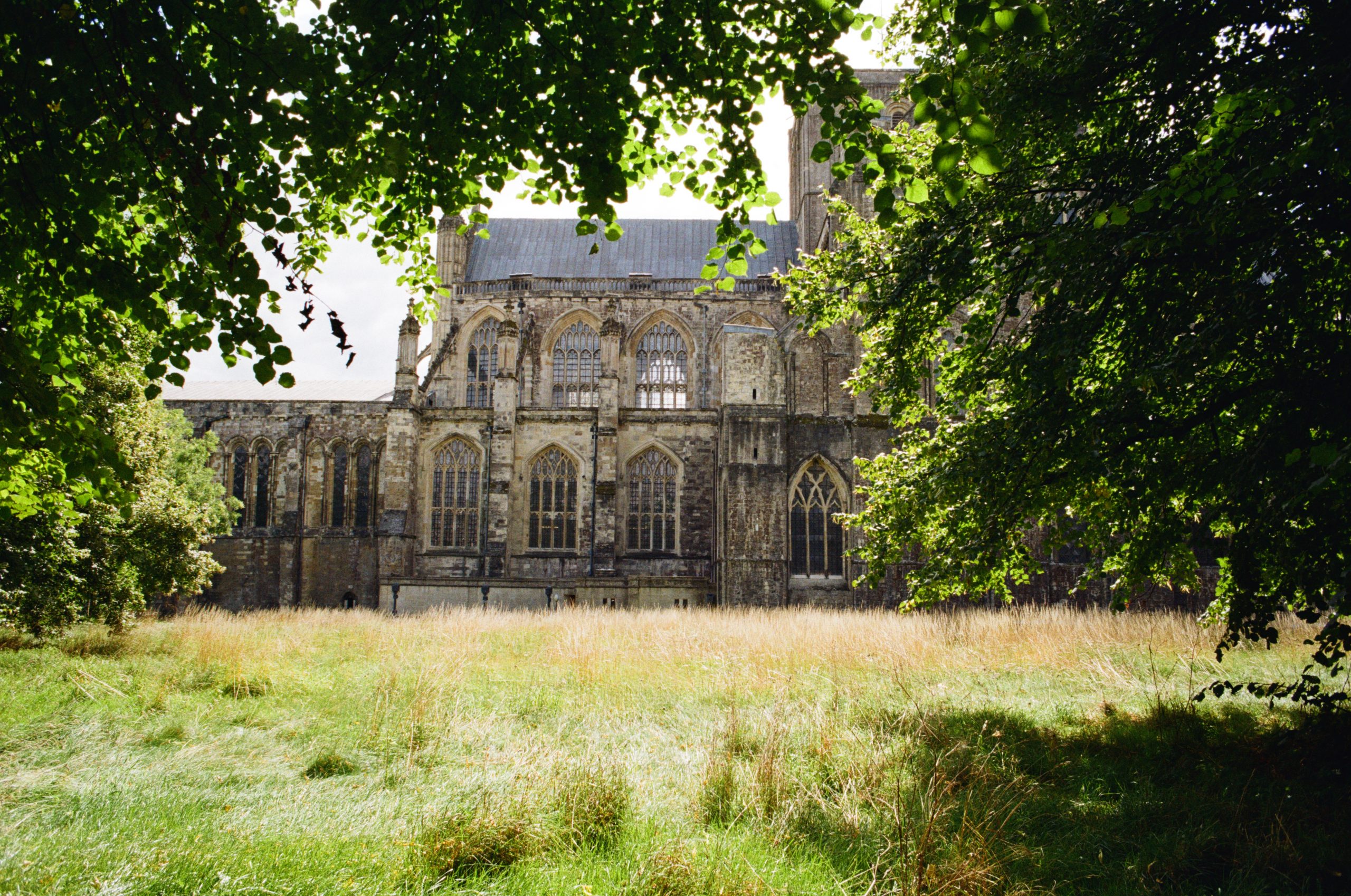
Winchester Cathedral through trees — Canon AE-1 Program, Kodak Gold 200
“The Cathedral brickwork shows exactly what Kodak Gold does best — warm stone in good light, rendered with a richness that feels genuinely timeless.”
Winchester — The Right City for This Film
Winchester is a good test for any warm-toned colour film. The Cathedral, the medieval architecture, the flint and limestone of the older streets — all of it responds well to a film with a warm bias. The golden tones that Kodak Gold pushes into stone and brick feel sympathetic rather than artificial here. This is not a film I’d choose for overcast conditions or for landscapes where cool, neutral tones matter — but for a city with this much warm stone in afternoon light, it earns its place.
The street scenes are where the film’s character becomes more complex. Kodak Gold handles busy, colourful environments — market stalls, crowds, shop fronts — with an energy that suits the subject. The colours are punchy without being garish. The grain at box speed is present but not dominant — fine enough that it adds texture rather than obscuring detail.
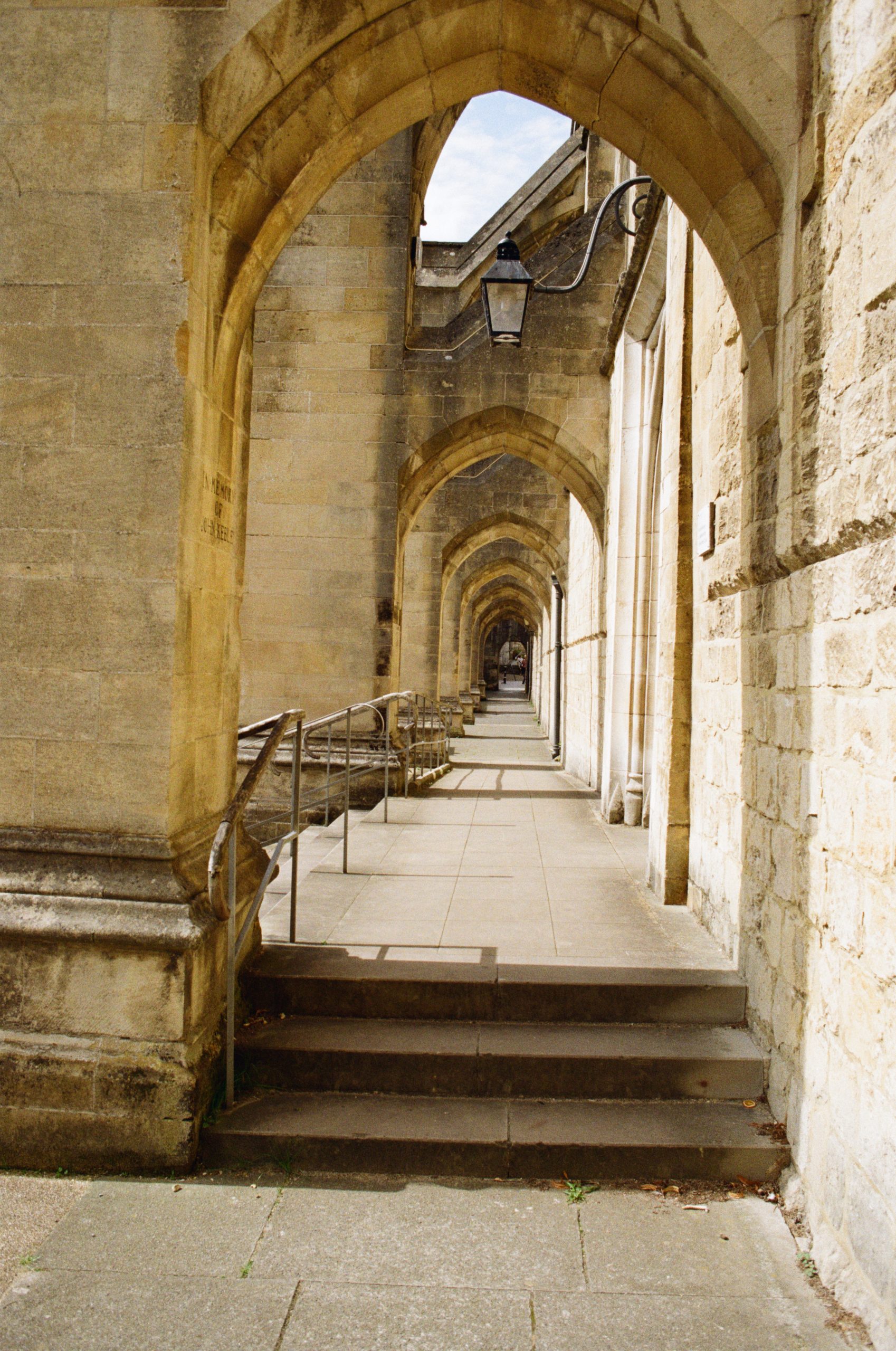
Winchester Cathedral brickwork — Kodak Gold 200’s warm tones on warm stone
Where It Performs Well
Kodak Gold 200 is at its best in daylight with some warmth in the light — late morning to late afternoon in summer, golden hour in any season. It suits architecture, street photography, travel, and any subject where warm, slightly enhanced colour works with rather than against the scene. Winchester’s Cathedral and historic core are exactly the kind of subject this film was made for.
The exposure latitude is genuine — I found it particularly forgiving when shooting in and out of shadow in the Cathedral grounds, where the contrast between deep shade and bright sky would challenge many films.

Winchester street scene — Kodak Gold 200 at box speed ISO 200
Where It Has Limitations
The warmth that makes Gold so appealing in the right conditions becomes a liability in others. In overcast British light — the flat, cool, diffused conditions that are actually the norm here for much of the year — Kodak Gold’s warm bias produces muddy, slightly brown shadows and muted greens. It is not a film for the grey days that define a Hampshire autumn or winter.
For that kind of light — and for the fine art landscape work that makes up most of my practice — I reach for black and white. Fomapan 400 or Ilford HP5+ handle those conditions far better. Kodak Gold is a film that needs the sun — and in the UK, you can’t always rely on that.

Winchester street scene — people and architecture, Kodak Gold 200
Can You Push Kodak Gold 200?
Yes — pushing to ISO 400 is a common approach and works reasonably well. The colours become slightly more saturated, contrast increases, and grain becomes more visible. It’s a useful technique if you’re shooting in lower light than the film ideally wants. That said, if you regularly need ISO 400, Kodak Ultramax 400 is a more natural choice — it’s designed for that sensitivity and handles it more cleanly. See the pushing film guide for more detail on the process.
Verdict
Works Well For
- Architecture in warm daylight
- Street photography in good light
- Travel and general outdoor shooting
- Warm stone, brick, and earthy tones
- Beginners — wide exposure latitude
- Summer and golden hour shooting
Consider Alternatives For
- Overcast British conditions
- Fine art B&W landscape work
- Low light or indoor shooting
- Cool, neutral colour palettes
- Fog and mist photography
Kodak Gold in Context — My Film Rotation
Kodak Gold 200 is not part of my regular film rotation. Most of my photography — the Roman walls at Calleva Atrebatum, the chalk ridge of Watership Down, the winter fog of the Hampshire countryside — is black and white work that doesn’t call for colour film. When I do shoot colour, I’m more likely to reach for Ultramax 400 in lower light or Gold when the sun is genuinely out and warm.
For the occasional colour roll — a day in Winchester, a summer afternoon somewhere interesting — Kodak Gold 200 is a genuine pleasure. It’s affordable, widely available, and produces images with a warmth and character that suits certain subjects beautifully. Just don’t ask it to perform in conditions it wasn’t designed for.
Looking for affordable B&W film instead?
Fomapan 400 available directly from the FineArtPics film shop — the B&W film used most regularly here.
Visit the film shop →Need more speed from a colour film?
Kodak Ultramax 400 is the natural step up — designed for lower light with a similar Kodak colour palette.
Read the Ultramax review →Frequently Asked Questions
Is Kodak Gold 200 good for beginners?
Yes — it’s one of the most forgiving colour films available. The wide exposure latitude means it handles over and underexposure well, which suits photographers still learning to meter. The warm tones are also flattering across a wide range of subjects. It’s a good first colour film, particularly if you’re shooting outdoors in reasonable light.
What is Kodak Gold 200 best used for?
Kodak Gold 200 works best in daylight — particularly warm, directional light that suits its warm colour bias. Architecture with warm stone or brick, street photography in sunny conditions, travel, and outdoor subjects in good light all play to its strengths. It’s less suited to overcast conditions, low light, or subjects where neutral colour accuracy matters.
Can you push Kodak Gold 200 to ISO 400?
Yes — pushing to ISO 400 is a common approach. The colours become slightly more saturated, contrast increases, and grain becomes more visible. It works reasonably well for an extra stop of sensitivity. That said, if you regularly need ISO 400 colour film, Kodak Ultramax 400 handles that sensitivity more naturally. See the pushing film guide for practical results.
How does Kodak Gold 200 compare to Kodak Ultramax 400?
The key differences are ISO (200 vs 400), grain (Gold is finer), and light requirements (Gold needs more). Gold has a warmer, slightly more vintage feel; Ultramax is more versatile across different lighting conditions. Gold suits sunny days and warm subjects; Ultramax suits a broader range of conditions including lower light. Both have that characteristic Kodak warmth, but Gold is more pronounced.
Where can I buy Kodak Gold 200 in the UK?
Kodak Gold 200 is widely available — Analogue Wonderland, AG Photographic, Wex Photo Video, and Amazon UK all stock it reliably. Prices currently sit around £9–£13 per roll in the UK. See the UK film suppliers guide for current prices and comparisons across retailers.
Is Kodak Gold 200 good for landscape photography?
It depends on the landscape and the light. For warm, sunny conditions — golden hour, summer afternoons, subjects with warm stone or earth tones — Gold produces beautiful landscape results. For the cooler, overcast, atmospheric conditions that characterise much of British landscape photography, its warm bias works against the scene. For that kind of light, black and white film — Fomapan or HP5+ — is usually more appropriate.