
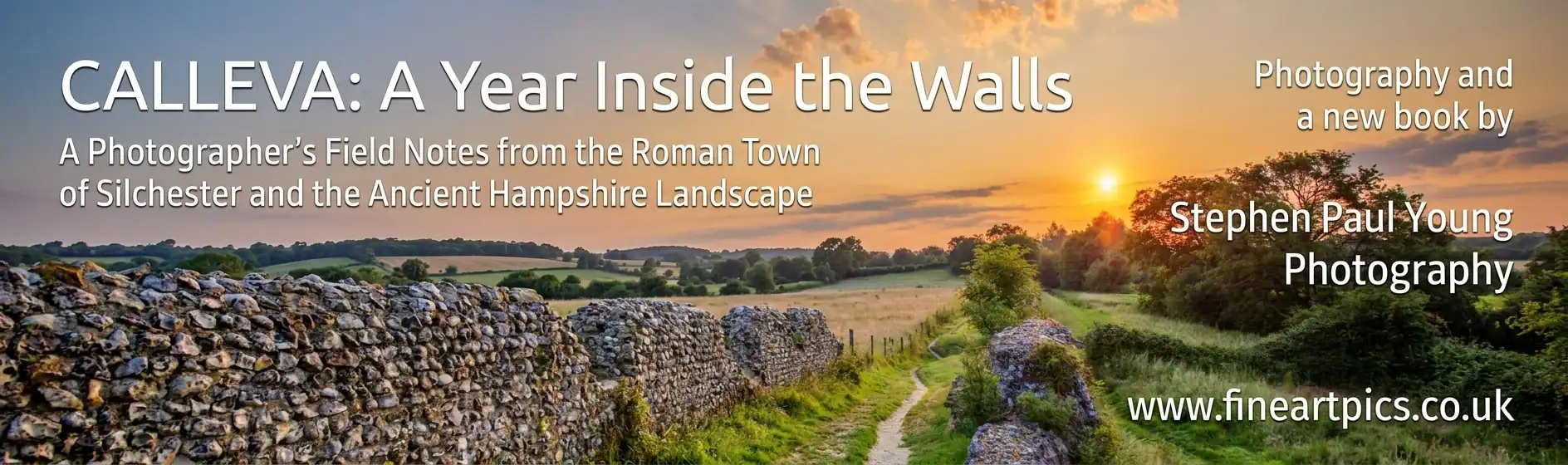
Some places refuse to let go of the past. Calleva Atrebatum — the Roman town buried beneath the fields of Silchester in North Hampshire — is one of them. I have been walking its walls since I was a boy. For more than fifty years, the same two miles of ancient flint and lime mortar, the same field interior, the same church tower above the hawthorn at the south gate.
Four or five years ago, I began to photograph Calleva in earnest — with film and digital cameras, before sunrise, in every weather a Hampshire year could produce. The result is my new book: CALLEVA: A Year Inside the Walls.
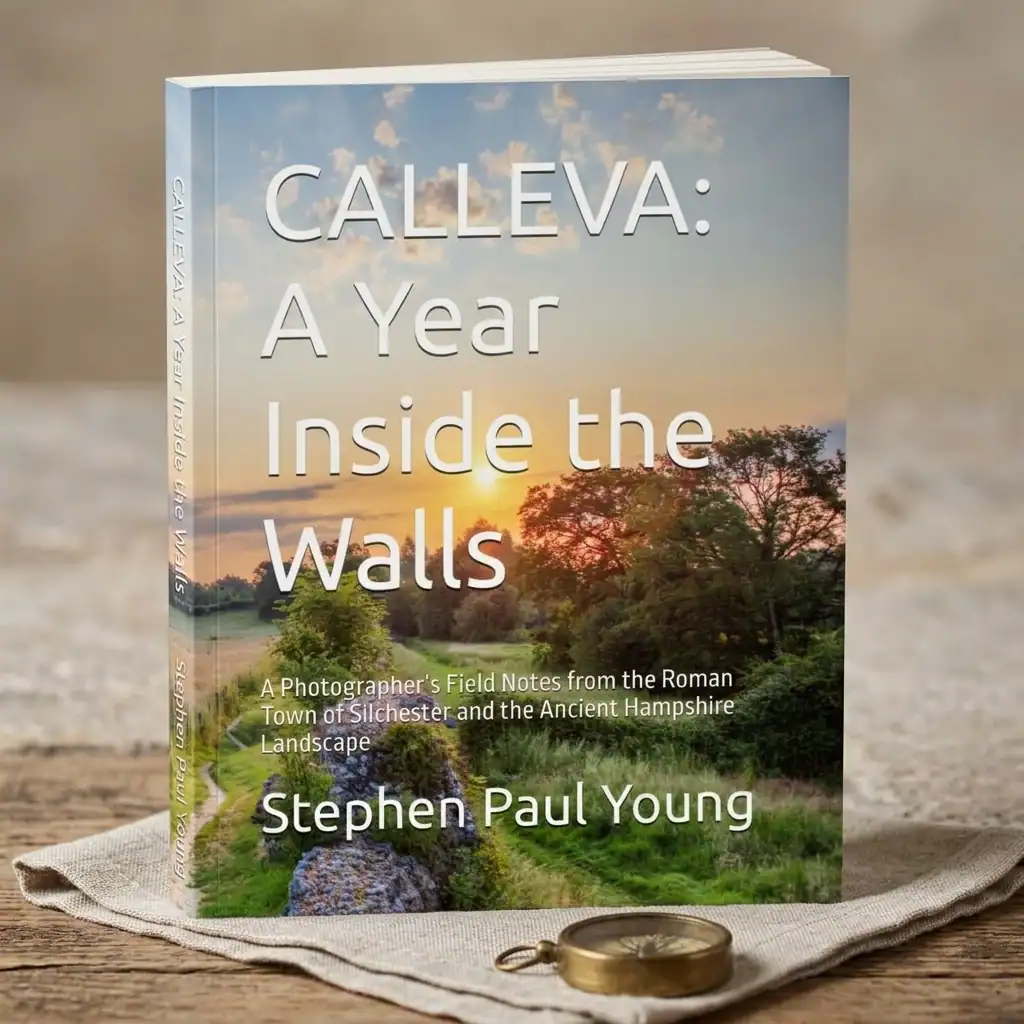
CALLEVA: A Year Inside the Walls
A photographer’s field notes from twelve months inside one of Britain’s best-preserved Roman town circuits. Photographs, natural history, folklore, and the quiet character of a Hampshire landscape across all its seasons. Available now in paperback on Amazon UK.
Buy on Amazon → All BooksWhat the Book Is — and What It Isn’t
This is not a history of Calleva Atrebatum. That has been written by archaeologists far better qualified than I am. It is not a guide to Roman Hampshire. There are leaflets for that, and the University of Reading’s Silchester Archaeology Project publishes more rigorous material than I could produce.
What CALLEVA: A Year Inside the Walls is — is a photographer’s account of what a landscape reveals when you give it your full attention across all its seasons. Twelve months of field notes and photographs from inside one of the best-preserved Roman town circuits in Britain. The observations are specific: January frost on two-thousand-year-old flint. Elder in flower above the wall in June. The buried street plan pressing through dry July grass. October fungi on the ancient earthworks. The mistle thrush singing from the churchyard yew in November.
“What matters, in the end, is whether the image is honest about the place.”
A Year at Calleva — Month by Month
The book follows the arc of twelve months — but the images span four to five years of working at the site. A photograph made three years ago in an October mist belongs in the October chapter if it is the truest record of what October at Calleva looks and feels like. The camera does not need to have been there in the same year as the words. What matters is whether the image is honest about the place.
On Shooting with Film and Digital at the Same Site
I photograph Calleva with more than two cameras. The digital camera is a full-frame mirrorless body — capable, fast, forgiving in low light. For much of what I need at this site, it is the right tool. The early morning light before sunrise, the mist that lasts twenty minutes and is gone, the fieldfare flock moving through the hawthorn — these require speed.
The film camera is slower in every respect, and that is why I bring it. Photography becomes less about taking and more about noticing. Each frame costs something. The thinking that goes into a frame when you know there are only thirty-six of them — or twelve, on medium format — is different from the thinking that goes into a frame when the card holds a thousand. You look longer. You consider more carefully. You wait for the image to arrive rather than going to find it.
At a site like Calleva, where patience is exactly what the place rewards, this discipline matters. I process my own black and white film. The process is slower than digital in every direction, and I have come to regard that slowness as a feature rather than a limitation.
The digital photographs and the film photographs are not presented separately in the book. They are chosen for what they say about each month — not for what medium they were made on.
Natural History, Folklore, and the Living Wall
Calleva is not just an archaeological site. It is a living landscape, and the book treats it as one. The elder that grows head-high along the old wall bank in summer. The hawthorn — steeped in Celtic folklore as the fairy tree, the threshold between this world and the Otherworld — whose haws the winter fieldfares strip bare each January. The blackthorn blossom appearing on bare dark stems in March, one of the most beautiful things the British countryside produces. The snowdrops in St Mary’s churchyard in February, flowering in soil undisturbed since the medieval period.
Each plant has a story. Each bird has a relationship with the wall structure — the jackdaws nesting in the broken sections, the fieldfares working the hawthorn above it, the redwings in the leaf litter below. The book weaves natural history and plant folklore through the monthly observations, because Calleva cannot be understood without them.
“The landscape is always becoming something else. Never fixed. Never finished.”
Visiting Calleva — Practical Information
The book includes a full practical guide to visiting Calleva Atrebatum at Silchester — for photographers and general visitors alike.
Getting There
Address: Wall Lane car park, Silchester, Hampshire · Postcode: RG7 2HP
What3Words: ///verbs.adapt.functions · GPS: 51.3614°N, 1.0892°W
Parking: ~40 spaces, pay via RingGo app · Up to 2hrs: £2 · Up to 4hrs: £4
By train: Mortimer station (GWR, Reading–Basingstoke line) · approx. 2 miles walk to the walls
Circuit: 2.2 miles · Flat · Allow 1.5–2 hours · Waterproof boots recommended Oct–Apr
Entry: Free — no admission charge to walk the walls
Best Times for Photography
January: Sunrise after 8am · Frost on the flint · Raking light all morning
April–May: Sunrise around 5:30–6:00am · Blossom · Best early light of the year
October: Sunrise 7:00–7:30am · Autumn colour · Mist most reliable · Peak season
November–December: Sunrise 7:30–8:00am · Bare walls · Long shadows · Quietest months
Note: The car park opens at 8am — for early morning photography in summer, you’ll need to park on the lane and walk in.
About the Echoes of Calleva Project
This book sits alongside the long-term Echoes of Calleva photography project on this site — a sustained photographic engagement with the same landscape that has produced fine art prints, gallery work, and now this book. The project also connects to the free Field Journals — Issue Two of which explored Calleva in black and white film photography.
If you are interested in purchasing fine art landscape prints from Calleva, these are available through the FineArtPics print shop.
Available Now
CALLEVA: A Year Inside the Walls
Paperback · Available on Amazon UK · Illustrated throughout with film and digital photography, colour and black and white
Buy on Amazon UK →
