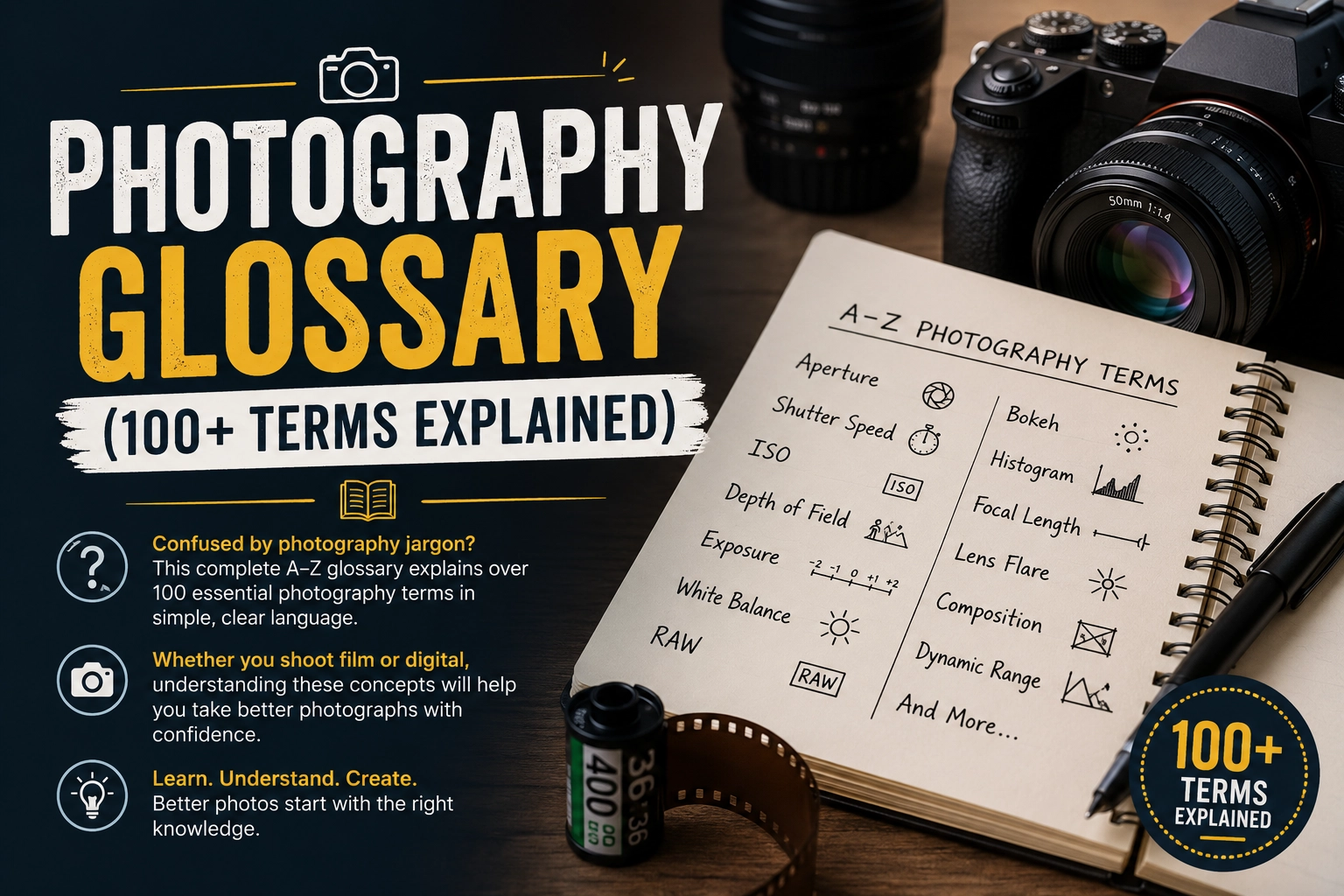
What this is: A complete A–Z glossary of photography terms — whether you shoot film or digital, understanding these concepts will help you take better photographs with confidence.
A
The opening of a lens that controls how much light enters the camera and affects depth of field. A wide aperture (low f-number) creates a shallow depth of field, while a narrow aperture keeps more of the scene in focus.
A system that automatically focuses the lens on a subject.
The proportional relationship between the width and height of an image.
Natural light available in a scene without added lighting.
Visual distortion that appears as jagged edges in digital images.
B
The aesthetic quality of out-of-focus areas in a photograph.
Taking multiple images at different exposures to ensure correct exposure.
Shooting multiple frames in quick succession.
Lighting coming from behind the subject.
Photography without colour, focusing on contrast, light, shadow, and texture. Learn more in the black and white photography guide.
C
The arrangement of elements within a photograph.
The difference between light and dark areas.
Removing parts of an image to improve framing.
Colour fringing caused by lens imperfections.
A reflection of light in a subject’s eyes.
D
The area of an image that appears in focus. A shallow depth of field isolates a subject, while a deep depth of field keeps more of the scene sharp.
The range between the darkest and brightest parts of an image.
A digital camera using a mirror system.
Grain-like distortion in images, often at high ISO.
Combining two images into one frame.
E
The amount of light that reaches the camera sensor, controlled by aperture, shutter speed, and ISO.
Adjusting brightness manually.
A number representing exposure level.
Adjusting an image after capture.
A digital display used for composing images.
F
Determines magnification and field of view.
Adjusting sharpness in an image.
Capturing images using photographic film rather than a digital sensor. Film introduces grain, dynamic range differences, and a slower, more deliberate process. Start with the film photography hub, or explore choosing the right film for different shooting styles.
Artificial light used to illuminate a subject.
Number of frames captured per second.
G
The soft, warm light shortly after sunrise or before sunset, ideal for landscape photography.
Texture in film or high ISO images.
A filter used to balance exposure between sky and foreground.
Harsh reflected light.
Tone curve of an image.
H
A graph showing brightness levels in an image.
The brightest areas in a photo.
Combining multiple exposures.
Mount for flash or accessories.
I
The sensitivity of your camera sensor to light. Higher ISO allows shooting in darker conditions but introduces noise.
Reduces blur from camera shake.
Focusing at a very far distance.
The part of the camera that captures light.
J
A compressed image file format.
Placing contrasting elements together.
Distortion from compression.
K
Measurement of colour temperature.
The main light source.
Light placed behind a subject.
L
Optical component used to capture images.
Using a slow shutter speed to capture motion over time, often used for water, clouds, or low light scenes. See motion blur photography techniques.
Lines that guide the viewer’s eye.
Shooting in minimal light.
M
Full control over camera settings.
Close-up photography of small subjects.
Measuring light for exposure.
Camera without a mirror system.
N
Grain or distortion in an image.
A neutral density filter that reduces the amount of light entering the lens, allowing for slower shutter speeds in bright conditions. Commonly used in long exposure photography techniques.
Light from the sun or environment.
O
Too much light in an image.
Zoom achieved through lens movement.
Flash not attached to camera.
P
The spatial relationship in an image.
A lens with fixed focal length.
Editing after capture.
Photographing people. See more in my portrait photography work.
Q
Reduced shutter noise.
Mounting plate for tripods.
R
Dividing an image into a 3×3 grid.
Unprocessed image file.
Used to bounce light.
S
How long the camera shutter stays open, affecting both exposure and motion blur. Faster shutter speeds freeze motion, while slower speeds create movement and blur effects. See motion blur photography techniques.
Dark subject against bright background.
Measuring light from a small area.
T
Lens for distant subjects.
Stabilises the camera.
Sequence of images over time.
U
Too little light.
Reduces haze.
V
Used to frame an image.
Darkening at edges.
W
Adjusting colour temperature.
Captures a wide field of view.
Your editing process.
X
Flash synchronisation speed.
Y
Enhances contrast in black and white photography.
Z
Variable focal length lens.
Exposure technique for tonal control.
Learn More Photography Basics
If you want to go deeper, explore the full collection of film and landscape photography guides, including film photography, black and white photography, and low light settings to build a stronger understanding of how these concepts work in real-world shooting.
What’s the difference between aperture and shutter speed?
Aperture controls how much light enters through the lens and affects depth of field, while shutter speed controls how long light hits the sensor and affects motion blur. Together with ISO, they form the exposure triangle.
What does ISO actually control?
ISO controls your camera sensor’s sensitivity to light. Higher ISO values allow shooting in darker conditions but introduce more digital noise or grain.
What is depth of field and why does it matter?
Depth of field is the range of an image that appears in sharp focus. A shallow depth of field isolates a subject from its background, while a deep depth of field keeps most of the scene sharp.
Do I need to understand these terms if I shoot in automatic mode?
Understanding these terms helps you recognise why an image looks the way it does, even in automatic mode, and gives you the vocabulary to make deliberate creative choices as you progress.
What’s the difference between RAW and JPEG?
RAW files are unprocessed and retain the most image data for editing flexibility, while JPEG files are compressed and processed in-camera, resulting in smaller file sizes but less room for adjustment.
Why is golden hour recommended for landscape photography?
Golden hour light is soft, warm, and directional, reducing harsh shadows and adding a flattering glow to landscapes compared with the flatter light of midday.
What’s the difference between film grain and digital noise?
Film grain comes from the physical structure of light-sensitive crystals in the film itself, giving a organic, textured look, while digital noise is an electronic artefact of the sensor, particularly at higher ISO values.
This article is part of my Photography Guides hub series.