
Some mornings stay with you because of the light. Others are memorable because of the place itself. At Silchester, in the Hampshire countryside, those two things came together on a misty winter dawn, among the remains of an ancient landscape and the quiet shapes of bare trees.
Silchester Roman Wall Misty Dawn is a photograph about atmosphere as much as history: the soft winter light, the rough texture of old stone, and the feeling of standing somewhere where the past is never very far away.
A landscape with a long memory
Silchester is associated with Calleva Atrebatum, one of the important settlements of Roman Britain. The surviving Roman town walls and earthworks are a reminder that this familiar patch of Hampshire countryside has a history stretching back almost two thousand years.
It is easy to think of history as something held in books or behind museum glass. But places like Silchester make the past feel closer. Fields, trees and old stone exist together in the present, while the ground beneath them has witnessed centuries of change. We cannot see the people who lived here long ago, but we can stand within this wider landscape and imagine the lives that once unfolded here.
That contrast is part of what draws me to historic landscapes. The photograph records one ordinary moment in the modern countryside, but the place gives that moment a deeper resonance.
The first light through the trees
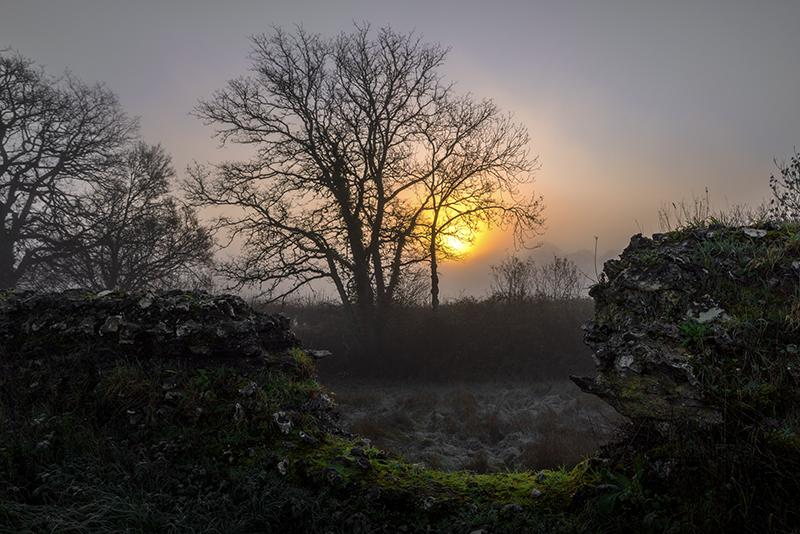
The dawn light was low and warm, glowing through the bare branches and catching the edges of the old wall. Around it, mist softened the landscape and muted the colours of winter. The contrast between the golden sun and the cool, shadowed stone gives the scene its quiet drama.
I like light that does not reveal everything at once. Mist creates distance and uncertainty; familiar shapes appear and disappear, and the eye begins to notice details that might otherwise be overlooked. The branches become delicate lines against the sky, while moss and winter growth add small touches of colour to the rough stone.
The details that make a photograph
For me, a landscape photograph is rarely about one thing alone. Here, the old stone gives the foreground weight and texture, the trees create a natural frame, and the light draws the eye towards the heart of the scene. The mist links those elements together, softening the distance and leaving room for the imagination.
The wall is weathered and uneven, with moss and small plants taking hold in its crevices. Those details matter. They speak of time passing quietly, without needing to explain themselves. The stone was built for a purpose in another age; now it forms part of a living landscape, shaped by weather and the seasons.
This photograph is part of my wider exploration of Calleva Atrebatum, the ancient Roman town at Silchester. Visit my Calleva Atrebatum photographic feature to explore more of its history, landscapes and photography.
A different view of the same morning
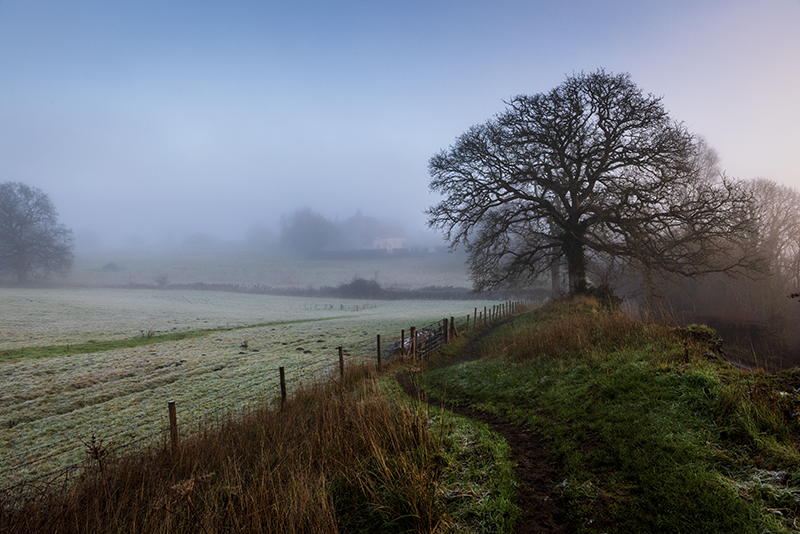
The same morning offered other moments worth keeping. Away from the wall, a frosted field and a solitary oak tree made a much quieter composition. A fence line led into the mist, guiding the eye across the pale grass towards a farmhouse barely visible in the distance.
There was no need for a dramatic subject. The oak’s branching shape, the soft division between field and sky, and the path disappearing into the haze were enough. The photograph feels open and still, with the cold colours of winter balanced by the warmer tones of the grasses and track.
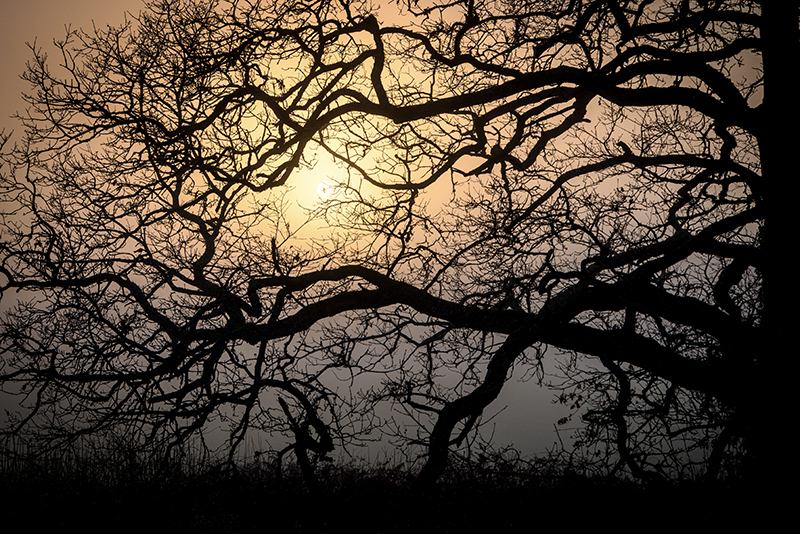
Looking up, the bare branches offered another kind of pattern. Against the pale dawn, they became a web of dark lines, each branch reaching into the light. It is a more abstract view of the morning, but it still carries the same sense of place: the quiet, the cold air and the subtle change from darkness into day.
Winter’s quieter palette
Winter can be generous to a photographer precisely because it strips a scene back. Without leaves on the trees or strong summer colours, structure becomes more visible. The eye starts to notice the shape of a branch, the texture of stone, or the gentle shift between frost, grass and mist.
The palette here is restrained: grey stone, pale sky, dark branches, muted greens and the warmth of the rising sun. I find that kind of balance calming. The photograph does not have to shout to hold attention; it can invite the viewer to spend a little time with it.
Making time to look
Photography encourages me to slow down and notice what is already there. A change in light, a veil of mist or the silhouette of a familiar tree can turn an ordinary walk into something worth remembering. That is one of the things I value about the quieter corners of North Hampshire: their beauty often reveals itself gradually, if we give them our attention.
Silchester Roman Wall Misty Dawn brings together the atmosphere of that winter morning and the long history of the place. It is not an attempt to recreate the Roman past. It is a record of the landscape as it appeared that day, with its ancient stone, bare trees and soft dawn light all sharing the same frame.
Bring the atmosphere home
If you are drawn to historic landscapes, subtle winter light and photographs that offer a moment of stillness, this image is available as a fine art print in two formats.
Explore the framed fine art print →
Explore the unframed fine art print →
Both versions feature my original photograph, captured in the real landscape around Silchester, Hampshire.
Stephen Paul Young
North Hampshire